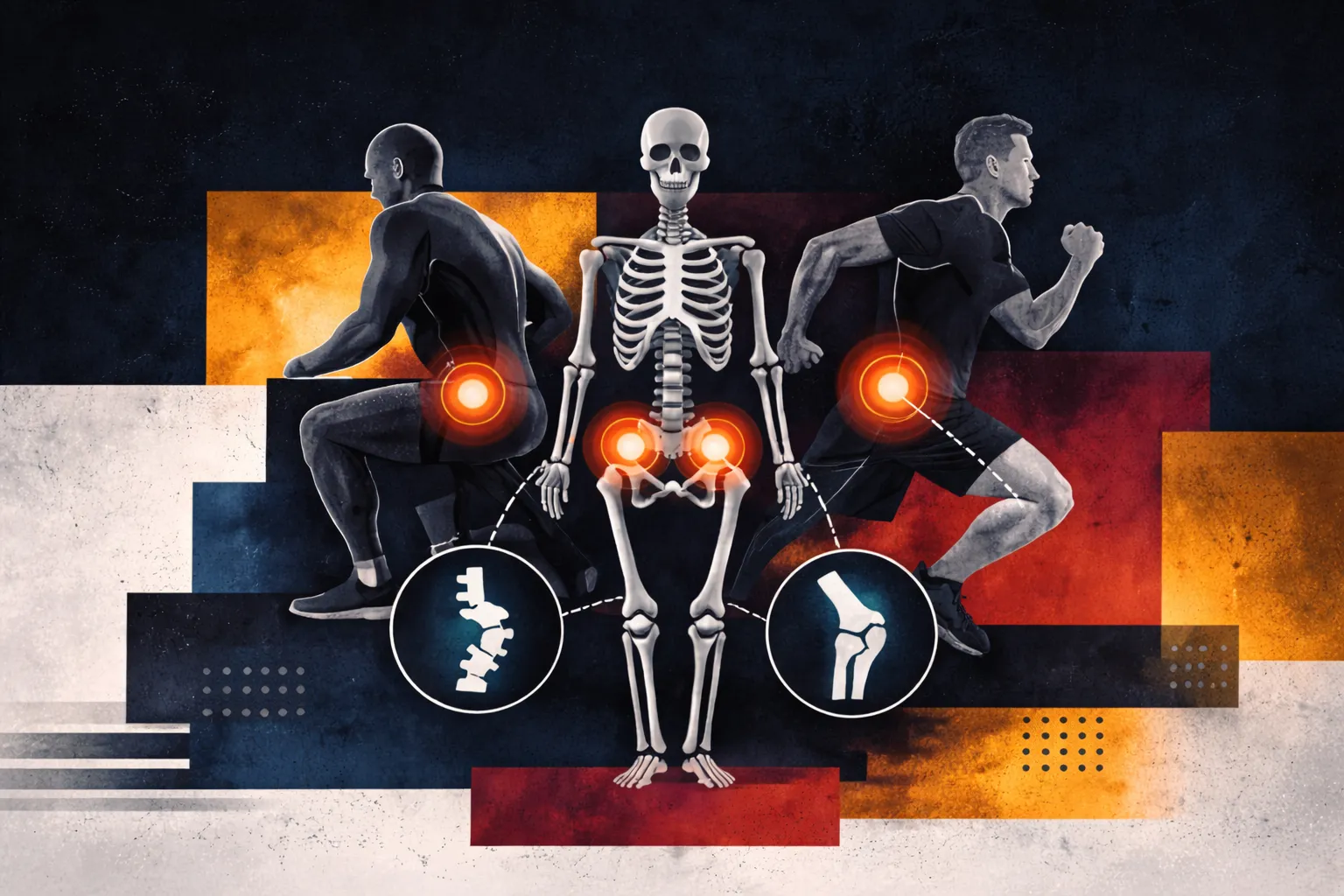
It's one of the most common things I hear from new patients at my Plymouth clinic: “I've been dealing with lower back pain for years. I've tried everything. Nothing works.”
And when I dig into their history, there's almost always a pattern. They've treated the back directly — adjustments, massage, pain medication, maybe even surgery — and gotten temporary relief. But the pain keeps coming back. Sometimes worse than before.
Here's what most people are never told: in the majority of cases, your back pain is not actually a back problem.
It's a movement problem. And until you address the root cause, you'll keep chasing symptoms for years.
The Real Cause of Most Lower Back Pain
Your spine is a remarkably strong and resilient structure. It's designed to handle significant load, movement, and stress over a lifetime. When it breaks down repeatedly, it's almost never because the spine itself is weak — it's because the structures around it are failing to do their job.
The lower back sits between two critical areas: the hips below and the thoracic spine above. When either of those regions loses mobility or strength, the lumbar spine compensates. It moves more than it should. It absorbs forces it wasn't designed to handle. And over time, it breaks down.
This is why I consistently see patients who have:
- Tight, immobile hips that force the lower back to rotate and extend beyond its capacity
- Weak glutes that fail to absorb ground forces during walking, running, and lifting
- A stiff thoracic spine that shifts rotational demand down to the lumbar vertebrae
- Poor core stability that leaves the spine without the muscular support it needs during movement
- Desk posture that keeps the hip flexors shortened and the glutes inhibited for 8 or more hours a day
Any one of these issues will eventually show up as lower back pain. When several of them exist together — which is common in active professionals who sit during the day and train hard on evenings and weekends — the lower back simply gets overwhelmed.
Why Traditional Treatment Keeps Failing
I want to be clear: chiropractic adjustments, physical therapy, and massage all have real value. I use and recommend all of them in the right context. But here's the problem with how lower back pain is typically managed:
Most treatment is focused entirely on the site of pain — the lower back itself. Adjustments mobilize the lumbar joints. Massage releases the paraspinal muscles. Anti-inflammatories reduce local swelling. These approaches provide relief, and that relief is real. But none of them address why the back is overloaded in the first place.
The moment treatment stops, the dysfunctional movement patterns return. The hip flexors tighten back up. The glutes stop firing. The thoracic spine stays stiff. And within weeks or months, the back pain is back.
This is the cycle most chronic back pain patients are stuck in. Not because treatment doesn't work — but because the treatment is aimed at the wrong target.
The SYMYO Approach: Treat the Cause, Not the Symptom
At SYMYO, the first thing I do with every back pain patient is a comprehensive movement assessment. I'm not just looking at the lower back. I'm looking at the entire kinetic chain — how the hips move, how the thoracic spine rotates, how the core stabilizes under load, how the body compensates during functional movement patterns.
This assessment tells me something far more valuable than an X-ray or MRI: it tells me why your back hurts. And with that information, we can build a plan that actually fixes the problem rather than just managing it.
A typical treatment plan for a back pain patient at SYMYO might include:
- Hands-On Treatment — Chiropractic care and soft tissue work to restore joint mobility, reduce muscle tension, and give the nervous system relief from the pain cycle.
- Hip Mobility and Strength Work — Targeted programming to restore full hip range of motion and build the glute strength needed to offload the lumbar spine.
- Core Stability Training — Not crunches and sit-ups. True core stability work that trains the deep stabilizing muscles to support the spine during real-world movement.
- Thoracic Mobility Restoration — Mobilizing the mid-back so that rotation and extension demands are distributed across the entire spine.
- Movement Pattern Retraining — Teaching the body to squat, hinge, rotate, and carry load correctly so that the spine is protected during daily life and training.
This is not a quick fix. It is a real fix — one that addresses the underlying dysfunction so that the results last.
Who This Applies To
If you recognize yourself in any of the following, the root-cause approach to back pain treatment is likely what you've been missing:
- You've had lower back pain for more than three months that keeps returning despite treatment
- Your back pain is worse after long periods of sitting and improves temporarily with movement
- You've been told your imaging looks “fine” but you're still in significant pain
- Your back pain came on gradually without a specific injury
- Your back tightens up during or after exercise even though you consider yourself fit
- You've had relief from adjustments or massage but the pain always comes back within days or weeks
These are all signs that your back is a victim — not the culprit. The culprit is somewhere else in your movement chain.
What Your Movement Age Tells Us About Your Back
One of the tools I use at SYMYO is Movement Age — a composite score that measures how old your body actually moves based on mobility, functional movement quality, and lifestyle habits.
In almost every case, patients with chronic lower back pain have a Movement Age that is significantly older than their chronological age. Restricted hips, compensated movement patterns, prolonged sitting, and inconsistent strength training all contribute.
The good news is that Movement Age is reversible. By restoring hip mobility, building core stability, and retraining movement patterns, patients consistently lower their Movement Age — and resolve the back pain that has limited them for years.
Back Pain Treatment Near Me: Plymouth, Canton, Northville, Livonia & Metro Detroit
If you've been searching for back pain treatment near me or chiropractor for back pain in Plymouth, Canton, Northville, Livonia, or anywhere in the Metro Detroit area — and you're tired of temporary fixes — SYMYO offers a different approach.
We don't just treat where it hurts. We find out why it hurts and build a plan that resolves the problem at its source. You deserve more than pain management. You deserve a body that actually works.
Ready to find out what's really causing your back pain?
Book Your Movement Assessment with Dr. Mitch Israel →
SYMYO Sports Therapy & Chiropractic | Farmington Hills, MI | Serving Plymouth, Canton, Northville, Livonia, and Metro Detroit