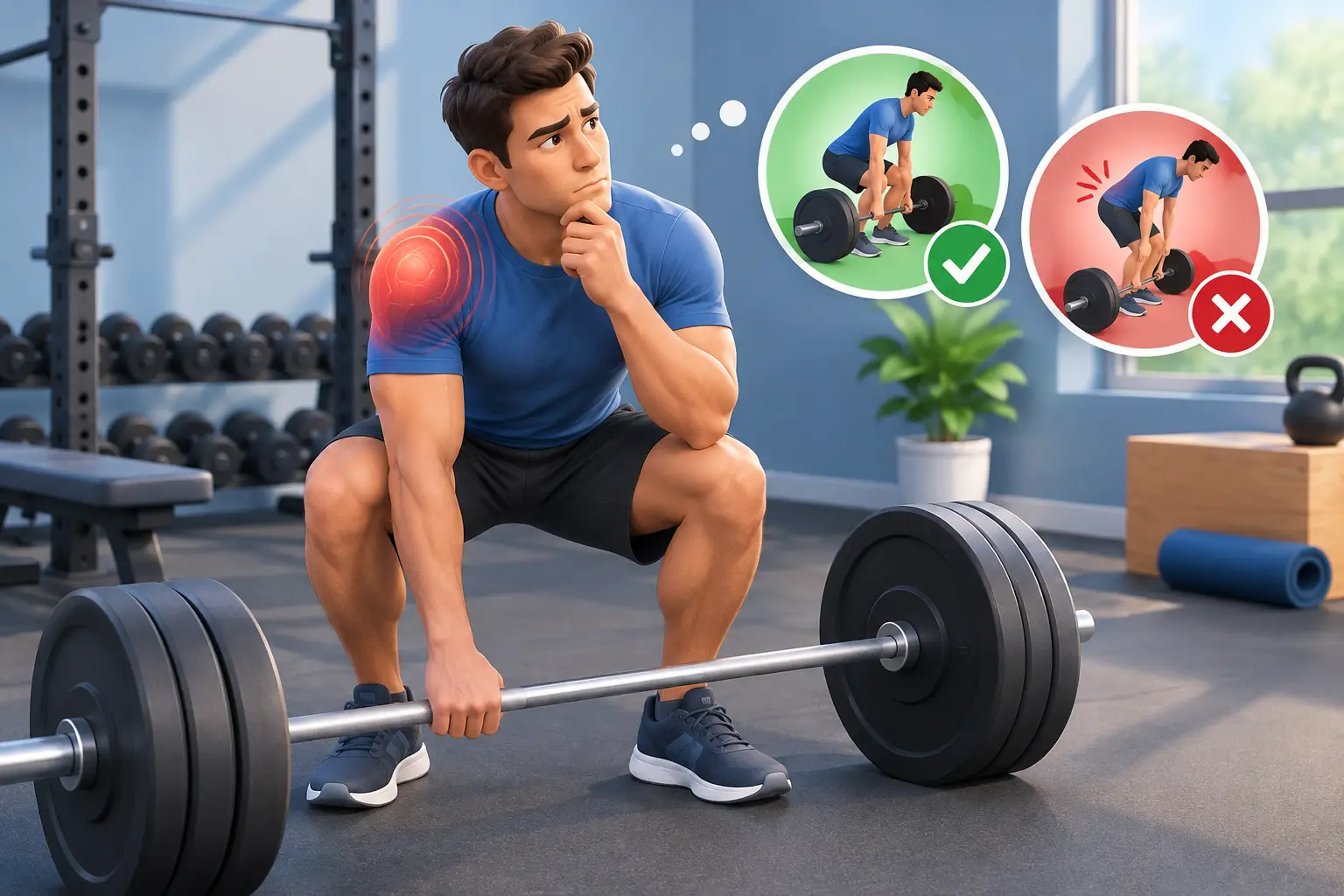
Is lifting safe with pain? Learn how to judge symptoms, modify training, spot warning signs, and build a clear return-to-strength plan with confidence.
A familiar pattern shows up in the gym: your back tightens during deadlifts, your knee complains on stairs, or your shoulder catches when you press. You want to stay active, but you do not want to turn a manageable issue into a bigger setback. So, is lifting safe with pain? Sometimes, yes. But the right answer depends on the type of pain, how it behaves during and after training, and whether the exercise can be adjusted without forcing your body to tolerate more than it is ready for.
Pain does not automatically mean damage, and no pain does not automatically mean every movement is a good fit. The useful question is not simply, “Can I push through?” It is, “What is this symptom telling me, and what level of training can my body handle right now?”
Is Lifting Safe With Pain? Start With the Pattern
Pain is information, but it is not a complete diagnosis. A muscle may feel sore after returning to training. A joint may feel stiff at the beginning of a session and improve as you warm up. Those experiences are different from sharp pain, a sudden loss of strength, or symptoms that steadily build from set to set.
Look at the full pattern. When did the pain begin? Was there a specific event, or did it develop gradually? Does it show up only under a certain load, at a certain range of motion, or during one exercise? Does it settle shortly after training, or is it worse that night and the next morning?
For many active adults, continuing some form of strength training is more productive than stopping all movement. Complete rest can lead to deconditioning, more stiffness, and less confidence using the affected area. But continuing with the exact workout that repeatedly aggravates symptoms is rarely a productive plan either. The middle ground is intelligent modification and progressive reloading.
Use a Simple Pain-Monitoring Framework
During an exercise, mild and stable discomfort may be tolerable for some people, especially if it does not increase as the session continues. As a practical guideline, discomfort in the low range, around 0 to 3 out of 10, that stays stable and returns to your usual baseline within 24 hours may be reasonable to monitor.
That is not permission to ignore pain. It is a way to observe your response rather than making every training decision based on fear. If symptoms rise during each set, change your form dramatically, cause you to guard the movement, or leave you clearly worse the next day, the dose was likely too high.
Think of training variables as dials you can turn. You can reduce the weight, shorten the range of motion, slow the tempo, lower the number of sets, or choose a different variation. A painful barbell squat, for example, does not mean all lower-body training is off the table. A supported split squat, box squat, sled exercise, hip hinge variation, or step-up may be better tolerated while you build capacity.
The same principle applies to upper-body training. If overhead pressing irritates your shoulder, it may help to temporarily use a landmine press, an incline press, a lighter dumbbell variation, or a more limited range. The best option is not always the exercise that feels easiest. It is the option that lets you train with good control, acceptable symptoms, and a clear path to progress.
The 24-Hour Response Matters
How you feel after training often provides more useful information than how you feel in one repetition. A workout may feel manageable in the moment because you are warm and focused, then leave you significantly more stiff, painful, or limited the next day.
Check your response later that day and the following morning. If your symptoms return to their typical level quickly, your current dose may be appropriate. If you have a noticeable flare that affects sleep, walking, work, or your next workout, scale back one or more variables before trying again.
This approach turns exercise into a controlled test rather than an all-or-nothing gamble. It also helps avoid a common cycle: feel better, do too much, flare up, rest completely, then repeat.
When Pain Means You Should Stop and Get Evaluated
Some symptoms deserve prompt medical attention rather than a modified workout. Stop lifting and seek appropriate evaluation if pain follows a major trauma or comes with obvious deformity, substantial swelling, inability to bear weight, a joint that feels unstable, or a sudden major loss of strength.
Other warning signs include numbness or tingling that is persistent or worsening, new bowel or bladder changes, numbness in the groin area, fever or unexplained illness with severe pain, or pain that is severe, unrelenting, and not tied to movement. These situations are not training problems to solve through exercise substitutions.
You should also consider an assessment when pain keeps returning despite reasonable modifications, when you cannot identify a tolerable way to train, or when an old injury keeps changing how you move. The goal is not to label every ache as serious. It is to understand what needs attention before the problem narrows your options further.
Why the Painful Area Is Not the Whole Story
The location of pain matters, but it may not be the only factor worth assessing. A painful knee can be associated with limited ankle mobility, reduced hip strength, poor single-leg control, or a recent jump in running and training volume. A sore low back may be influenced by hinge mechanics, trunk endurance, hip mobility, recovery, and the total load you are carrying in daily life.
That does not mean one limitation is always the cause of pain. Bodies are more complex than that. It does mean a whole-body look can reveal opportunities to make lifting feel more controlled and sustainable.
At SYMYO, this process starts by measuring movement, mobility, balance, strength, core stability, and relevant movement patterns. Rather than treating the painful spot in isolation, the goal is to identify what may be contributing, determine what needs to improve first, and build a plan that fits the person in front of us.
Build Back to the Lift You Want to Do
A good return-to-strength plan has a destination. If you want to deadlift, run, golf, play pickleball, or keep up with demanding workouts, your rehab and training should gradually prepare you for those demands.
Start with a version of the task your body can tolerate. Then progress one variable at a time. You might first improve control with a bodyweight hinge, then add a kettlebell from an elevated position, then increase range, then load. This is usually more effective than jumping from rest directly back to your previous working weight.
Progress is not always linear. A busy work week, poor sleep, extra yard work, a long drive, or a new recreational activity can all affect your tolerance. Adjusting the plan is not failure. It is part of training with clear measurements and useful feedback.
Do Not Let Fear or Stubbornness Make the Decision
Pain can push people toward two unhelpful extremes. One person avoids all lifting because they assume every sensation is harmful. Another treats pain as a test of toughness and keeps repeating the same aggravating pattern. Neither approach builds much confidence or capacity.
The better approach is specific: keep the movements you can perform well, modify the ones that exceed your current tolerance, and progressively rebuild the strength and mobility your goals require. If you are unsure where to start, an individualized movement assessment can give you a clearer baseline and remove the guesswork.
Your body does not need a perfect workout to move forward. It needs a training dose it can recover from, a plan that progresses with purpose, and enough patience to let strength become part of the solution.