Shoulder Mobility · Upper Body
How to Release Tight Lat Muscles: A Simple Guide to Better Shoulder Mobility
By Dr. Mitch Israel·Updated September 30, 2026
Do your lats always feel tight?
Maybe reaching overhead feels restricted. Maybe you notice it when lifting weights. Or every time you bring your arms overhead, your ribs flare and your lower back arches to make up for the movement you are missing.
Your first instinct may be to stretch your lats.
That can help. But if they constantly tighten back up, stretching may be only one piece of what you need.
I'm Dr. Mitch Israel, and I own SYMYO Sports Therapy here in Farmington Hills. I work with active adults who want to move better, get stronger, and keep doing the things they enjoy without fighting the same tight areas.
Here are three movements you can try to help your lats feel better, improve overhead movement, and build more control in that range.
Is Shoulder Tightness Keeping You From Moving the Way You Want?
If tightness, pain, or limited shoulder mobility keeps getting in the way of your workouts or the things you enjoy, tell me what has been going on. I'll review it and let you know if SYMYO may be able to help.
What Are Your Lats?
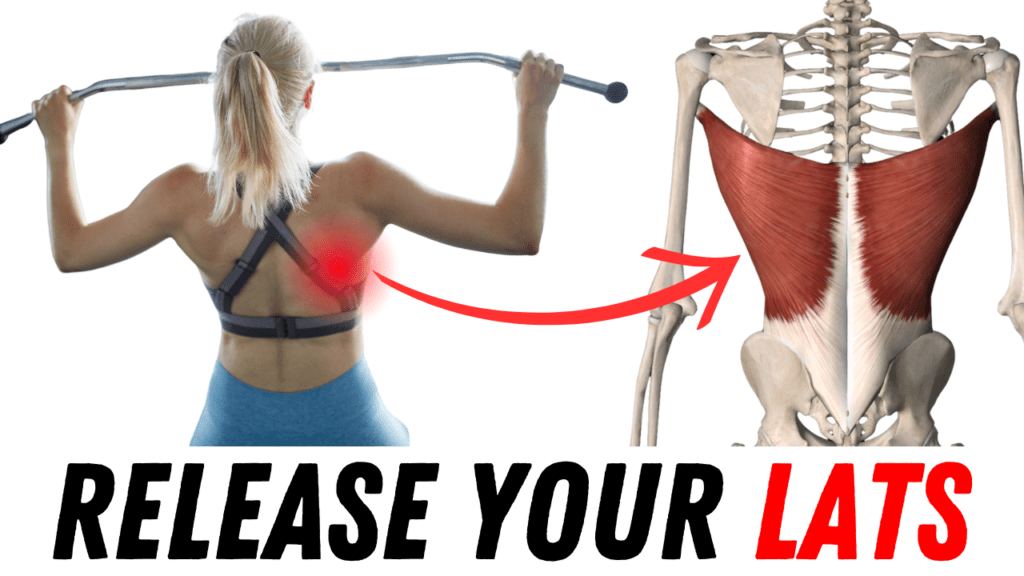
Your latissimus dorsi—usually called your lats—are large muscles that run from your lower and mid-back to your upper arm.
They are involved in many upper-body movements, especially pulling your arms down and back. Think pull-ups, rows, swimming, and climbing.
Because of where they attach, the lats can also influence how easily you bring your arms overhead.
If that movement is limited, your body may arch through the lower back and flare the ribs to get your arms where you want them.
That is why I do not only look at where someone feels tight. I want to know how it affects the way they move.
Why Do Your Lats Feel So Tight?
There is not one reason everyone's lats feel tight.
Pull-ups, rows, swimming, climbing, and upper-body training can create a lot of work for them.
If you spend most of the day sitting and rarely move your shoulders through a full range, reaching overhead may also feel restricted.
Training, daily activity, shoulder mobility, upper-back mobility, and strength can all play a role.
Feeling tight does not automatically tell us what your body needs. You may benefit from stretching, restoring movement somewhere else, or building better control and strength.
What Is the SYMYO Method?
At SYMYO, I use a simple three-step approach to help people move from pain or limitation back toward what they want to do.
Reduce: Reduce the pain, stiffness, irritation, or limitation that is currently getting in the way.
Restore: Restore the mobility, control, and movement your body needs.
Reinforce: Build strength and capacity so your body is better prepared for what you want to do.
Reduce → Restore → Reinforce.
Step 1 · Reduce
Lat Stretch Using a Door Frame
- Grab a sturdy frame and rotate your thumb slightly downward.
- Round your upper back slightly.
- Sit your hips back and lean away from your hand.
- Rotate your opposite shoulder slightly toward the arm you are stretching.
- Find a comfortable stretch through your lat.
- Take 10–15 slow breaths through your nose and out through your mouth.
Do not crank on the stretch. Find a position where you feel the lat lengthen and spend time breathing there.
Step 2 · Restore
Prone Swimmers
- Lie face down with your hands resting on your lower back.
- Lift your hands and elbows away from your body.
- Slowly move your arms out and around toward the top of your head, almost like swimming.
- Reverse the movement and return your hands to your lower back.
- Complete 10–15 slow, controlled repetitions.
Do not force a huge range. Use the movement you can control and gradually work through more as it improves.
Step 3 · Reinforce
Overhead Arm Raises
- Lie on your back with your knees bent and feet on the floor.
- Start with your arms reaching toward the ceiling.
- Keep your ribs and lower back controlled.
- Slowly bring your arms overhead without letting your ribs flare or your lower back arch.
- Return to the starting position.
- Complete 10–15 controlled repetitions.
Use a smaller range that you can control. Reach farther only as your mobility and control improve.
What If Your Lats Still Feel Tight?
If these exercises help, great. Keep using them and see how your overhead movement changes.
If you constantly need to stretch just to feel loose—or shoulder mobility keeps limiting lifting, golf, swimming, or other activities—we may need to look deeper.
I do not know how your shoulders or upper back move, whether your lats actually limit your range, or how strong you are overhead.
I also do not know whether the thing that feels tight is what we need to work on.
Instead of assuming you need another stretch, I can assess how your body moves, determine what deserves attention, and build a plan around you.
Sometimes that is mobility. Sometimes it is strength. Sometimes we need to work somewhere other than the area that feels tight.
When Should You Get Shoulder Pain or Tightness Evaluated?
There is a difference between feeling stiff and having pain you should stop trying to stretch through.
If you have sharp or worsening pain, significant weakness, numbness or tingling, or symptoms traveling down your arm, have it evaluated rather than continuing to push through it.
If you have stretched the same area for weeks or months without much changing, that is another reason to take a closer look.
These exercises are educational and are not a diagnosis or individualized treatment plan.
Common Questions About Tight Lats
Why are my lats always tight?
There is not one answer. Training, daily activity, shoulder mobility, upper-back mobility, and strength can all affect how the area feels. If you keep stretching and the tightness returns, it is worth asking whether tightness is the problem or simply what you feel.
Can tight lats limit shoulder mobility?
They can contribute to limited overhead movement because the lats attach to the upper arm and influence shoulder motion. They are not the only possible limitation, so it helps to look at how your shoulder, upper back, and trunk move.
Can tight lats cause lower back pain?
Limited overhead movement can lead some people to compensate by extending through the lower back. That does not mean tight lats automatically cause back pain, but repeatedly arching your back to reach overhead is worth paying attention to.
What’s the best stretch for tight lats?
The door-frame stretch in this article is simple and easy to adjust, but there is no single best stretch for everyone. If stretching helps only temporarily, you may need to look beyond stretching.
How often should I stretch my lats?
There is no magic number. Gentle mobility work can be used regularly if it feels good and helps you move better. If you feel like you must stretch the same muscle every day just to function normally, it is worth finding out why.
Where can I get help with shoulder mobility near Farmington Hills?
SYMYO Sports Therapy works with active adults in Farmington Hills whose shoulder pain, stiffness, or mobility problems make it harder to exercise and stay active. We start by understanding how your body moves and what you need to work on.
Still Fighting the Same Tight Lats?
If you keep stretching and your shoulders still feel restricted, you probably do not need another random stretch.
The SYMYO Movement & Performance Assessment looks at your mobility, strength, balance, and movement so you can understand what is working well, where there is room to improve, and what deserves your attention.
Then we can build a plan around you instead of guessing.
Learn About the AssessmentAbout Dr. Mitch Israel
I'm Dr. Mitch Israel, a sports chiropractor and rehab specialist and the owner of SYMYO Sports Therapy in Farmington Hills, Michigan.
I created SYMYO to help people do more than temporarily feel better.
My goal is to help you understand your body, improve what needs improving, and build the strength and confidence to keep doing the things you enjoy.
When general advice is not enough, a personalized assessment and plan can make the difference.
SYMYO Sports Therapy
33930 West 8 Mile Road, Suite 2AFarmington Hills, MI 48335
Serving Farmington Hills, Novi, Northville, Livonia, Plymouth, West Bloomfield, Farmington, and surrounding Metro Detroit.