Mobility Training in Farmington Hills

Move Better. Stay Active. Keep Doing More.

Maybe your hips don’t move like they used to.

Reaching overhead feels restricted.

Rotating through your back has gotten harder.

Or certain positions at the gym just don’t feel as comfortable as they should.

So you stretch. It feels good for a little while—but somehow you always end up feeling tight again.

That’s because improving mobility isn’t always about stretching more.

At SYMYO Sports Therapy in Farmington Hills, mobility training starts by measuring how you move, identifying the limitations that actually matter for your goals, and training your body to move through those ranges with more control and strength.

Want to Move Better?

Tell us where you’re feeling limited and what you’d like your body to be able to do.

Step 1 of 425%
1. What would you most like to get back to doing?

Select all that apply.

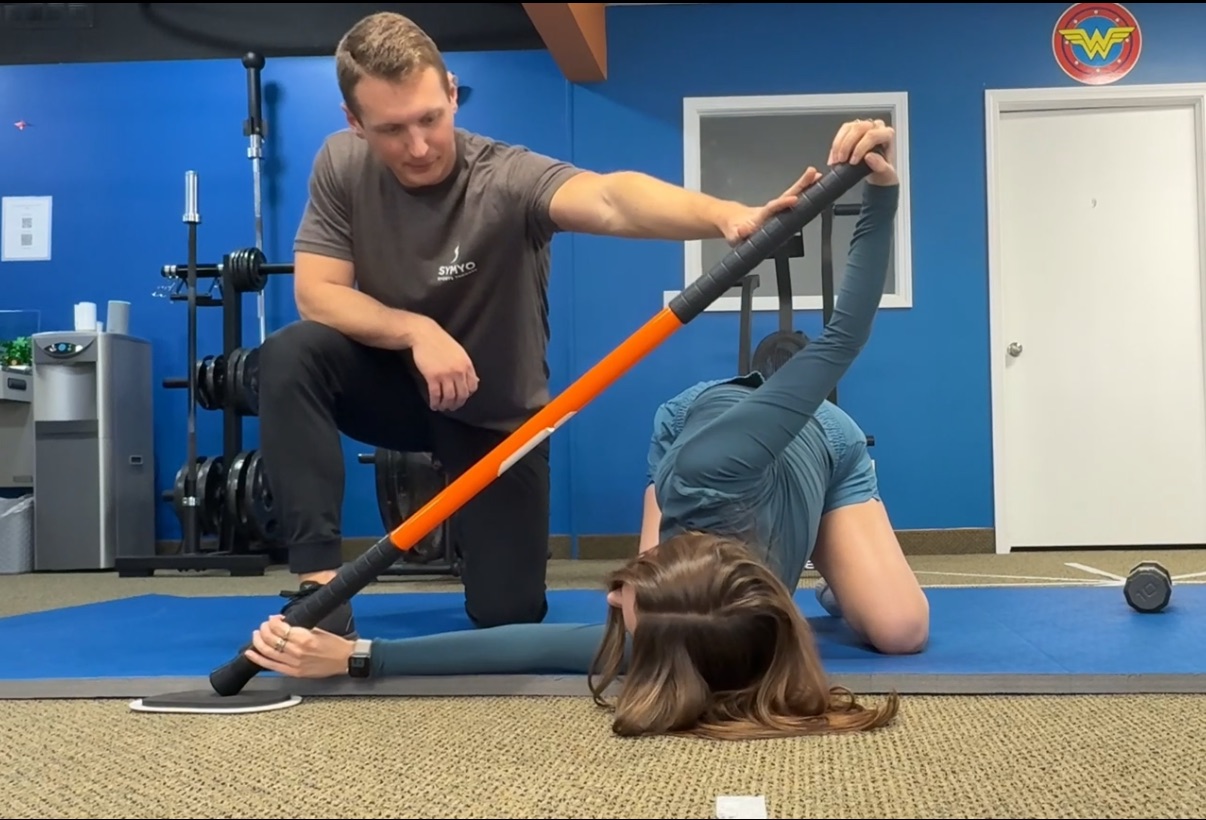
Mobility training with Dr. Mitch at SYMYO

What Does Good Mobility Actually Mean?

Mobility isn’t about being able to do the splits. You don’t need every joint in your body to be as flexible as possible.

You need enough movement for the things you want to do.

If you want to squat comfortably, your ankles, hips, and spine need enough movement to get you there. Reaching overhead needs help from your shoulders and upper back. Golf requires rotation through your hips and spine. Getting down on the floor and back up requires several areas to work together.

Your mobility should match your goals.

We’re not trying to make every movement test perfect. We’re trying to identify the limitations that actually matter for you.

Why Do You Still Feel Tight Even Though You Stretch?

Feeling tight and actually having limited mobility aren’t always the same thing.

You may genuinely need more range of motion. But you may already have plenty of movement and need more control or strength instead.

Or the area that feels tight may not be what’s limiting the movement.

That’s why endlessly stretching whatever feels tight can become frustrating. Before trying to improve mobility, it helps to know what you’re actually missing.

Stop Guessing. Start Measuring.

You can find thousands of mobility routines online. The hard part is figuring out which exercises you actually need.

Depending on your goals, we may assess things like:

  • Hip and shoulder mobility
  • Spinal rotation
  • Ankle mobility
  • Squatting and reaching overhead
  • Differences between your left and right sides
  • Strength and control through different ranges

We may also use AI-assisted movement analysis to objectively measure certain movements.

Then we put those findings in context.

Finding a limitation doesn’t automatically mean we need to fix it. The important question is whether it is getting in the way of something you want to do.

Mobility Is More Than Stretching

Stretching can help improve range of motion. But useful mobility requires more than being able to passively stretch into a position.

We think about mobility in three steps:

Get Into the Position

First, you need enough available range of motion. If you genuinely don’t have it, we work on improving it.

Control the Position

Next, your body needs to actively move into and control that range. It’s not enough to have someone push you into a position. We want you to be able to get there.

Get Strong in the Position

Finally, we progressively strengthen the range. If your goal is to squat, lift, golf, run, play sports, or simply move confidently, your body eventually needs to tolerate load.

That’s how mobility becomes useful.

What Mobility Training at SYMYO Looks Like

You don’t need another random 20-minute stretching routine. Your mobility training should be based on what your body needs and what you’re trying to accomplish.

Targeted Mobility Work

We focus on the joints and movements that need more range rather than stretching everything.

Active Mobility & Control

Once you have access to a position, we’ll teach your body to actively move into and control it.

Strength Through Range

We’ll progressively load the positions you’re trying to improve so your mobility becomes something you can actually use.

Training for Your Goals

Your mobility work should connect to something. That might mean squatting more comfortably, reaching overhead, rotating for golf, moving through yoga, getting on and off the floor, or simply feeling less restricted.

The goal isn’t to become really good at mobility exercises. It’s to move better during the things you actually care about.

You Don’t Have to Be in Pain to Work on Your Mobility

Maybe nothing really hurts. You just notice that:

  • You can’t squat like you used to
  • Your golf swing feels restricted
  • Reaching overhead is harder
  • Getting off the floor isn’t as easy
  • Certain exercises feel awkward
  • Your body simply feels stiffer than you’d like

You don’t need to wait for those things to become painful before working on them.

Physical health isn’t only about fixing things when they hurt. It’s also about maintaining the movement and strength that let you keep doing what you enjoy.

The Goal Isn’t to Be More Flexible

The goal is to make your body more useful to you.

Maybe you want to get back into the gym, swing a golf club more freely, move through a yoga class, squat comfortably, get down on the floor and back up, or simply keep moving well as you get older.

That’s why mobility matters—not because you need to pass an arbitrary flexibility test, but because having enough movement and being able to control it helps you keep doing the things you enjoy.

Mobility Training in Farmington Hills

SYMYO Sports Therapy provides individualized mobility training for active adults in Farmington Hills and throughout Metro Detroit who want to move better, get stronger, and stay active.

We combine movement assessment, mobility training, corrective exercise, and strength training to identify which limitations matter and help you improve them.

You don’t need to be injured.

If you feel stiff, restricted, or simply want your body to move better, we’ll start by figuring out where you are today and what may be worth improving.

Patient Stories

What Patients Say About SYMYO

Real experiences from patients who wanted clearer answers and a better way forward.

★★★★★

“Very up to date on all the cool new technology to help find the problem and help me feel better in the long run. He really listens and understands your issues.”
CH

Candis H

★★★★★

“He seeks solutions to problems rather than temporary relief. My overall pain has gone down, and my strength and mobility have gone up.”
SP

Sam P

★★★★★

“The approach Dr. Mitch takes is much different than most. His plan of care gets you back to where you want to be so you can achieve your goals.”
KH

Kathryn H

★★★★★

“He helped subside the pain, educated me on movements I could do on my own, and helped me rebuild my weak links.”
CM

Cody M

★★★★★

“He takes the time to understand the root cause instead of simply treating the symptoms. You can tell he wants long-term results, not temporary relief.”
CM

Callie M

★★★★★

“It was the most thorough appointment I have ever experienced, and I left feeling confident that I am in the right hands for my recovery, strengthening, and overall well-being.”
TS

Tracey S

★★★★★

“It is not just popping some joints and sending you on your way. Dr. Mitch creates a plan to help prevent the issue from coming back in the future.”
JL

Jacob L

★★★★★

“It is a team effort. The adjustments complement the program and are not just the quick fixes I have had in the past.”
LC

Lisa C

★★★★★

“He explained his thought process and what was going on, which gave me confidence in the approach and helped me stop worrying about a serious injury.”
JN

Justin N

★★★★★

“I was looking for someone to help me understand what was physically wrong. The full-circle explanations and visual aids make the process approachable and inviting.”
JS

Jay S

★★★★★

“As a collegiate runner, Dr. Mitch helped me strengthen my knees and hips in just a few weeks.”
JL

Jack L

★★★★★

“The mobility assessment was very detailed and revealed useful information. I love that I can use the assessment bundle to track my progress over the next year.”
PT

Patti T

Mobility Training FAQ

What’s the difference between mobility and flexibility?+

Flexibility generally refers to how much range of motion is available. Mobility includes your ability to actively move through and control that range. We want you to have enough range for your goals—and be able to actually use it.

Why am I stiff even though I stretch?+

Feeling stiff does not always mean you lack flexibility. You may need more range of motion, but strength, control, activity level, and how much time you spend in certain positions can also affect how your body feels.

Is mobility training just stretching?+

No. Stretching can be one tool, but mobility training can also include active movement, control exercises, loaded mobility, and strength training through greater ranges.

Can I improve my mobility after 40 or 50?+

Yes. Your body can continue adapting to training as you get older. The goal is not necessarily to move like you did at 20. It is to maintain and improve the movement that is useful for your life now.

Do I need to be in pain to come to SYMYO?+

No. Some people come because something hurts. Others want to improve their mobility, strength, balance, or overall physical function so they can stay active.

Want to Move Better?

See If SYMYO Can Help

If you constantly feel stiff, stretching isn’t changing much, or you simply want your body to move better, you don’t have to guess what to work on. We’ll measure how you move, identify which limitations matter, and help you build the mobility, control, and strength to do more.

Step 1 of 425%
1. What would you most like to get back to doing?

Select all that apply.

SYMYO Sports Therapy — Farmington Hills, Michigan