See how a movement age assessment measures mobility, stability, strength, and movement quality, then turns results into a clear action plan for life.
If you can still work out, golf, run, or keep up with a busy schedule, but your body feels less capable than it used to, a movement age assessment can give you a clearer starting point than pain alone. It looks beyond the spot that hurts or feels stiff to measure how your whole body is moving, supporting itself, and handling the demands you place on it.
For many active adults, the frustrating part is not a single bad day. It is the pattern: your back tightens up after a long drive, your knee complains when you return to running, or your shoulder limits your strength training again. You may be able to push through, but that does not tell you what needs attention first. Clear measurements can.
What Is a Movement Age Assessment?
A Movement Age™ is a practical way to describe how your current physical capacity compares with what is expected for your chronological age. It is not a diagnosis, a prediction of your lifespan, or a label that defines what you can do. It is a snapshot of how your body performs across the movement qualities that support an active life.
Those qualities include mobility, balance, stability, strength, core control, posture, and the way you perform common movement patterns. Your actual age matters, but so does your ability to get up from the floor, control a single-leg position, rotate comfortably, squat, hinge, carry, and tolerate exercise without repeatedly feeling held back.
A person in their 50s may have movement capacity that compares favorably with someone much younger because they have maintained strength, mobility, and consistent activity. Another person may be active but have a higher Movement Age because restrictions, weakness, poor control, or old injuries are affecting how they move. Neither result is a verdict. Both are useful information.
Why Pain Alone Is Not Enough
Pain deserves attention, but it is not always a complete map of what your body needs. A sore knee, for example, may be associated with a change in how you control your hip, ankle, or trunk during a squat, step-down, or run. A stiff neck or recurring low back pain may occur alongside limited upper-back mobility, reduced shoulder control, or a general lack of strength capacity.
That does not mean every movement limitation causes pain. Bodies are more complex than that. It does mean that looking at the whole body can reveal factors that may be contributing to a recurring problem or making it harder to return to the activities you enjoy.
Symptom-focused care can be helpful when you need relief, but relief alone does not automatically improve your ability to train, lift, play sports, or stay active over time. If the same issue returns when you increase activity, the next question should be: what demand is your body struggling to handle, and why?
What a Movement Age Assessment Measures
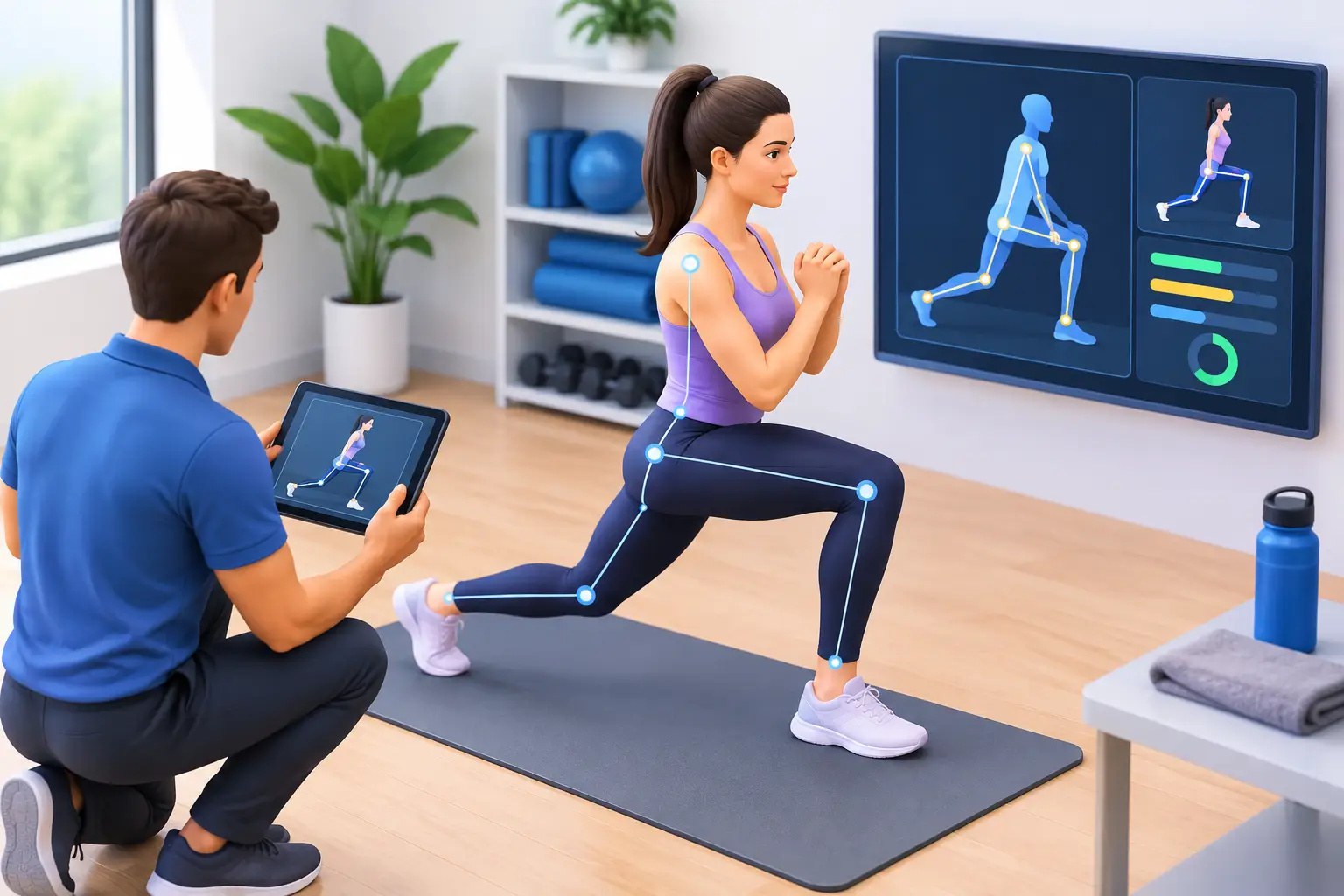
A comprehensive assessment turns broad concerns like “I feel tight” or “my body is breaking down” into specific findings. At SYMYO, the Movement & Performance Assessment combines AI-assisted movement analysis with physical testing to evaluate the areas that most influence physical capacity.
Movement patterns and mobility
Your provider watches how you move through patterns such as squatting, hinging, stepping, reaching, rotating, and balancing. The goal is not to make every movement look perfect. It is to identify meaningful restrictions, compensations, or control issues that may limit your exercise choices or place more demand on certain areas.
Mobility testing helps clarify whether a joint or region has enough usable range of motion for the activities you want to do. For a golfer, that may include rotation through the hips and upper back. For someone who strength trains, it may include shoulder motion and ankle mobility during loaded movements. The useful question is always relative to your goals: enough mobility for what?
Stability, balance, and core control
Mobility without control is not always useful. An assessment also looks at how well you can stabilize through your trunk, hips, shoulders, and single-leg positions. Balance testing can show whether you can maintain control when your base of support narrows or when one side has to do more of the work.
These findings matter because daily life and training rarely happen in perfectly symmetrical, controlled positions. Walking stairs, carrying groceries, changing direction on a tennis court, and getting up from the ground all require your body to coordinate strength and stability.
Strength and physical capacity
Strength testing is not about proving how much weight you can lift. It helps establish whether your current strength matches your needs and whether one area may be underperforming compared with another. A person who has avoided loading because of pain may have lost capacity in ways that are not obvious until they try to return to the gym or a favorite sport.
Physical capacity also includes how well you tolerate repeated effort. Someone may have enough strength for one good repetition but struggle to maintain form, control, or confidence through a set of exercises or a full round of golf. That distinction helps shape a plan that is challenging without being needlessly aggressive.
Posture and body composition
Posture can provide useful context, especially when it is considered alongside movement and strength testing. It should not be treated as a simple explanation for pain or a problem to “correct” into one ideal position. People move and hold themselves in different ways. What matters more is whether you can access options, control your body, and tolerate the positions your life requires.
Body composition is another data point, not a judgment. Alongside strength and movement measures, it can help create a more complete Physical Health Report and establish a baseline for progress.
How to Use Your Movement Age Results
The value of a Movement Age score is not the number by itself. The value is understanding what influenced it and what to work on first.
A useful report prioritizes findings instead of handing you a long, overwhelming list of exercises. If limited ankle mobility is affecting your squat but reduced hip strength is the bigger barrier to your knee control, your plan should reflect that. If pain is making it difficult to load an area, you may need hands-on treatment and rehabilitation before progressing into more demanding strength work.
At SYMYO, this process follows the Reduce, Restore, Reinforce method. First, reduce the factors that are limiting comfortable movement and training. Next, restore mobility, control, and confidence through targeted rehabilitation. Then reinforce those gains with progressive strength training so your body is better prepared for real life, exercise, and sport.
The order can vary. A runner with a recent flare-up may need a different starting point than a healthy adult who wants to improve their Movement Age before increasing gym training. The assessment helps make that decision based on your body, your current capacity, and your goals.
Who Can Benefit From an Assessment?
A movement age assessment is especially useful if you are active but dealing with recurring back, neck, shoulder, hip, or knee symptoms. It can also help if you have become more cautious in the gym, feel stiffer than you did a few years ago, or are unsure how to return to activity after an injury.
It is equally valuable when pain is not the main issue. Many adults in Farmington Hills and the surrounding Metro Detroit area want a baseline before they train harder, start a new sport, or simply make sure they are building the strength and mobility needed for the years ahead.
The assessment does have limits. A score cannot capture every part of your health, replace appropriate medical evaluation for concerning symptoms, or guarantee that an injury will not happen. It can, however, replace guesswork with a practical picture of your current physical capacity.
A Better Starting Point Than Guesswork
You do not need to wait until pain forces you to stop doing what you enjoy. A clear assessment can show where your movement is strong, where capacity may be limited, and which improvements are most likely to make a difference first.
The goal is not to chase a younger number for its own sake. It is to build a body that feels more capable when you train, move through daily life, and say yes to the activities that matter to you.