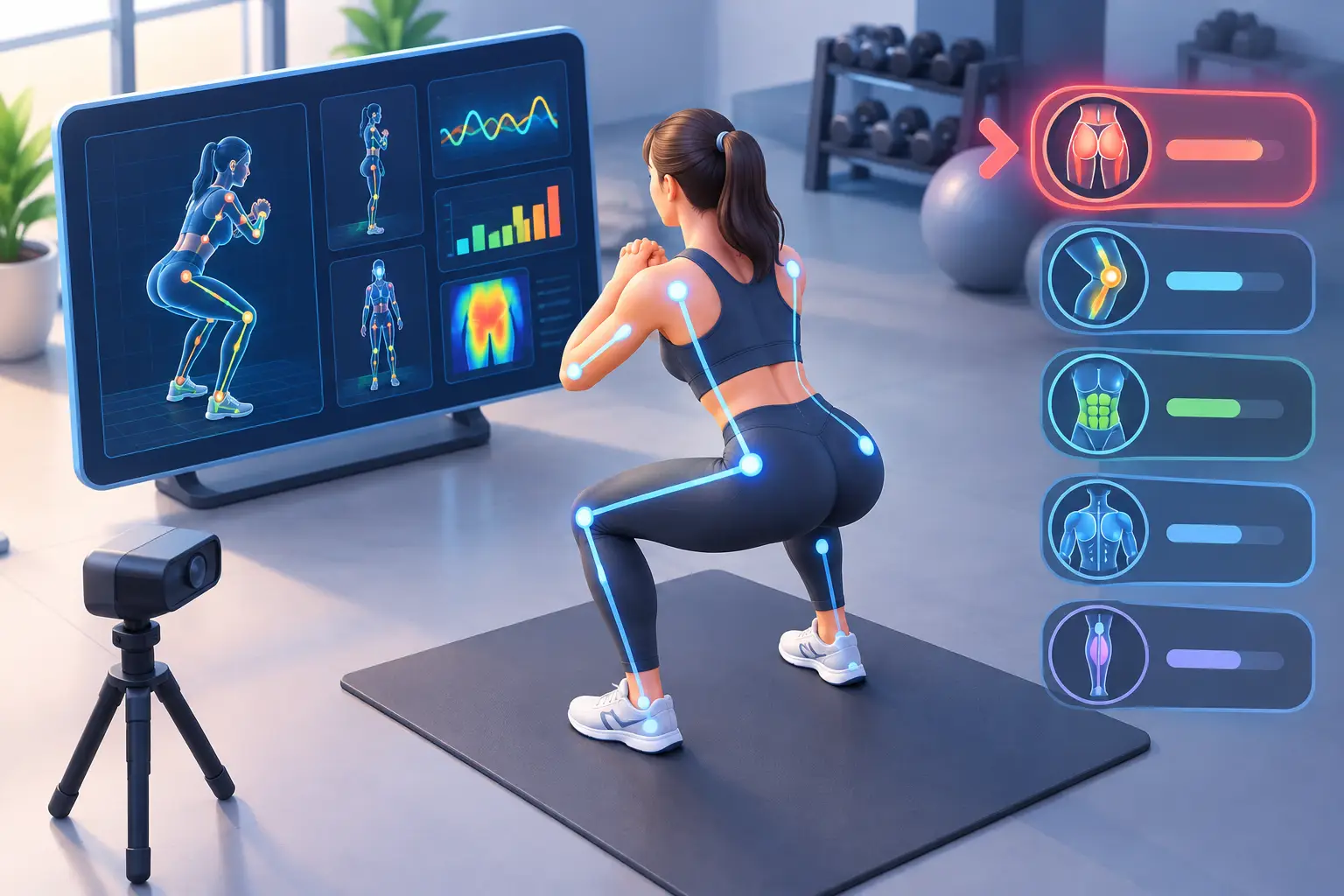
AI movement analysis measures how your body moves, helping active adults identify limitations, prioritize training, and build lasting capacity safely.
What Is AI Movement Analysis?
AI movement analysis uses camera-based technology and software to observe movement patterns and produce objective measurements. During an assessment, you perform a series of simple movements while the system tracks how different parts of your body move in relation to one another.
Depending on the assessment, this may include looking at posture, joint mobility, squat mechanics, balance, stability, range of motion, and right-to-left differences. The technology turns observations that can be difficult to quantify by eye into clear data points that can be reviewed over time.
This is not a diagnosis delivered by a camera. It also does not replace a conversation, a physical examination, or hands-on clinical judgment. It is a useful measurement tool. When paired with physical testing and an understanding of your goals, health history, training routine, and symptoms, it can make the assessment more complete.
That distinction matters because movement is personal. Two people can perform the same squat differently, and neither pattern automatically means there is a problem. The useful question is whether a movement pattern fits the person in front of you: their mobility, strength, activity demands, injury history, and the things they want to keep doing.
Why Measurements Matter When You Want to Stay Active
Many active adults know their body has changed, but they cannot pinpoint how. They may notice that getting up from the floor takes more effort, one hip feels tighter after golf, or a familiar workout now causes symptoms the next day. Those experiences are real, but they do not always tell you what to train first.
Clear measurements create a baseline. They can show where movement is limited, where control breaks down, or where asymmetries may deserve a closer look. Rather than guessing whether you need more stretching, more core work, or heavier strength training, you can build a plan around the findings that matter most.
The value is not in generating a long list of imperfections. Nearly everyone has some asymmetry or limitation. The value is in prioritization. If ankle mobility is limiting your squat depth but overall lower-body strength is the larger barrier to your goal, your plan should reflect that. If shoulder range of motion has improved but overhead control is still limited, the next phase should build stability and strength rather than simply adding more mobility drills.
For people who have been caught in a cycle of feeling better, returning to exercise, and flaring up again, this process can bring needed clarity. A recurring issue may be associated with more than one factor, including training load, recovery, mobility, movement control, and physical capacity. A thoughtful assessment helps organize those possibilities into practical next steps.
What AI Movement Analysis Can Measure
A useful assessment looks beyond one exercise or one body part. At SYMYO, AI-assisted movement analysis is part of a broader Movement & Performance Assessment that combines technology with physical testing. The goal is to understand how the whole body is functioning and where your current capacity may not match the demands you are placing on it.
Posture can provide one piece of the picture, particularly when it is considered alongside mobility and strength. It should not be treated as a verdict on whether your body is “aligned” or the source of every ache. More useful is understanding whether your posture, available range of motion, and movement habits are connected to the activities that feel difficult.
Mobility testing looks at how freely key areas can move. Restrictions at the hips, ankles, thoracic spine, or shoulders can change how you perform everyday tasks and training movements. A limitation does not automatically cause pain, but it may influence how your body distributes load.
Balance and stability testing help show how well you control your body, especially when weight shifts from one side to the other. This can be relevant for runners, golfers, recreational athletes, and anyone who wants more confidence with stairs, single-leg exercises, or uneven ground.
Strength and core stability testing assess your ability to produce and control force. Mobility without strength can leave you with range you cannot use well. Strength without adequate control or available motion can also make certain movements harder to perform comfortably. Looking at both helps create a more useful training plan.
A comprehensive assessment may also include body composition, physical capacity testing, and a Movement Age™ score. These measures are not about labeling you as good or bad at movement. They provide a starting point and a way to see progress that goes beyond whether symptoms happened to be quiet that week.
From Data to a Plan You Can Actually Follow
Numbers alone do not improve movement. The next step is translating findings into a plan that fits your life.
A well-designed plan should answer three questions: What is most likely holding you back right now? What should improve first? How will you know you are making progress? The answers may include hands-on treatment when appropriate, targeted mobility work, stability training, progressive strengthening, and adjustments to how you return to the activities you enjoy.
At SYMYO, this process follows the Reduce, Restore, Reinforce method. First, the focus may be on reducing symptoms or sensitivity that is making movement difficult. Next comes restoring the mobility, control, and confidence needed to move better. Then the work shifts toward reinforcing those improvements through progressive strength training and capacity-building.
The order can change based on the person. Someone returning to lifting after a flare-up may need to begin with controlled movement and lower loads. Someone who is not in significant pain but feels less capable than they used to may be ready to focus more directly on strength, balance, and performance. There is no universal corrective exercise or perfect movement score.
This is also why passive care alone is rarely enough for someone who wants to remain active long term. It may help create an opportunity to move more comfortably, but lasting improvement usually requires building the capacity to handle the demands of life, training, sport, and recreation.
Using AI Movement Analysis to Track Progress
The first assessment is valuable, but reassessment is where the process becomes especially useful. Repeating relevant movement screens after a period of rehabilitation or training can show whether the plan is producing meaningful change.
Progress might look like better squat depth with control, improved shoulder range of motion, more stable single-leg balance, or increased strength during a test that was previously limited. It can also look like returning to a regular workout schedule, playing a full round of golf with less hesitation, or feeling more capable during everyday activities.
Not every score needs to improve at the same speed. Sometimes pain decreases before strength catches up. Sometimes mobility improves first, while stability takes longer. Objective measurements help keep expectations realistic and let you adjust the plan based on what your body is showing, not just what you hope is happening.
Technology Is Helpful, but Context Comes First
AI can make movement assessment more consistent and easier to track, but it cannot know your goals on its own. It does not know that you want to train for your first 5K, keep up with your kids on the weekend, return to tennis, or feel confident under a barbell again. It also cannot determine your training history, tolerance for load, or the full context of an old injury without a professional evaluation.
The best use of AI movement analysis is as part of a conversation. Your measurements should be explained in plain language, connected to your real-world goals, and used to create an actionable plan rather than a report that sits in a drawer.
If your body has been sending mixed signals, start by measuring rather than guessing. A clear baseline can turn vague stiffness, recurring setbacks, and uncertainty about exercise into a focused plan to move better, get stronger, and keep doing the activities that matter to you.