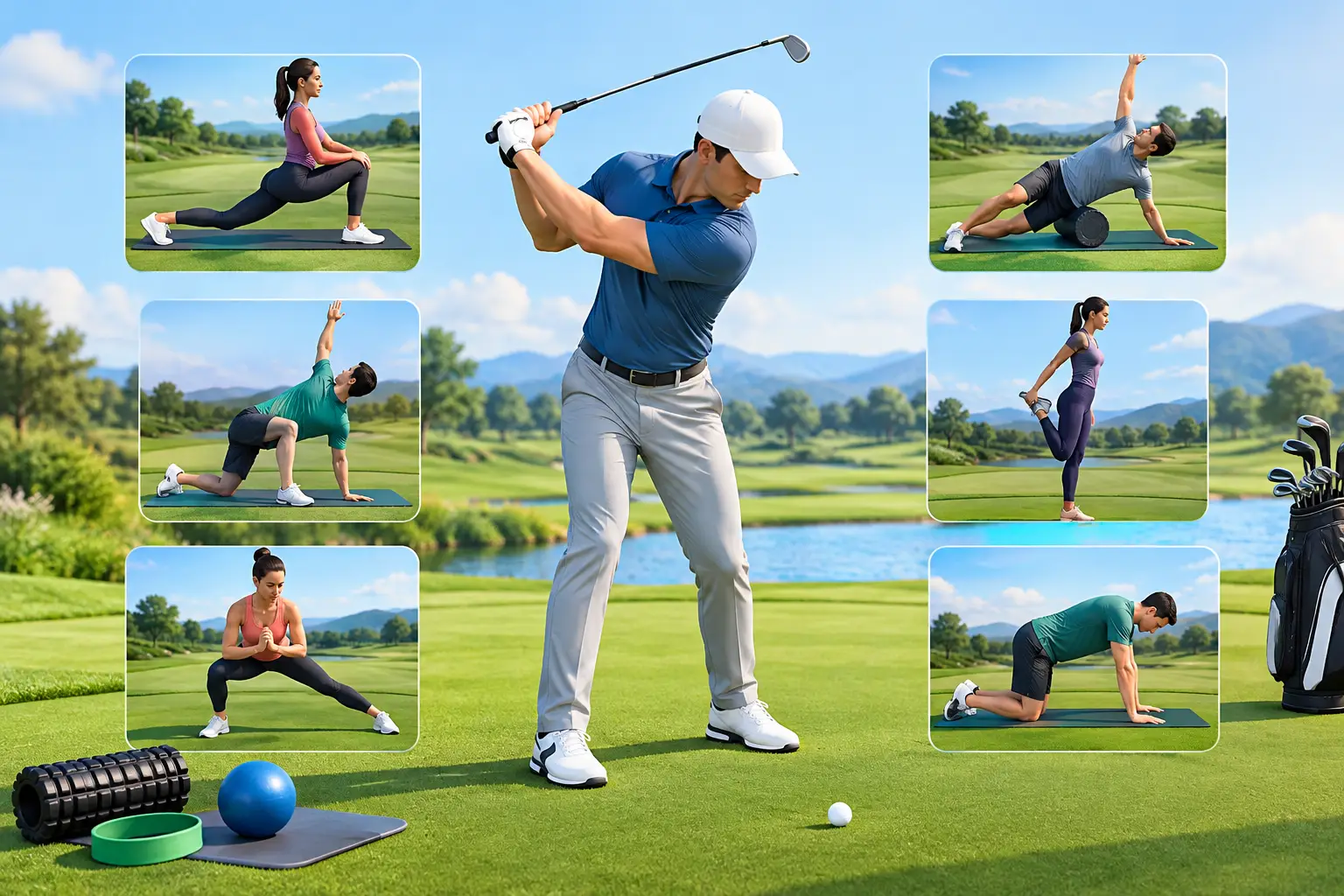
The best golf mobility drills improve rotation, hip motion, and shoulder control so active adults can swing with more comfort, balance, and confidence.
A golf swing asks your body to create speed through rotation while staying balanced over a small base of support. When your hips, upper back, shoulders, or ankles cannot move or control motion well, the body often finds a workaround. That may look like a shortened backswing, early extension, loss of posture, or extra stress through the low back. The best golf mobility drills are not about forcing a bigger turn. They help you access the motion your swing needs, then give you more control over it.
For active adults, especially those who notice stiffness after a round or during the first few swings on the range, the goal is simple: identify what needs to improve first, build it gradually, and support it with strength. A few intentional minutes before practice can be more useful than a long, random stretching routine.
Why golf mobility is more than flexibility
Golf mobility is the ability to move through the range needed for your swing with enough stability to use that range well. Flexibility is part of that picture, but it is not the whole picture. Someone can have loose hips yet struggle to control their pelvis during rotation. Another golfer may have plenty of shoulder motion but limited upper-back rotation, causing the shoulder or low back to do more than it should.
A useful mobility routine focuses on the areas that commonly need to share motion during a golf swing: the ankles, hips, thoracic spine, shoulders, and rib cage. It also respects the fact that every golfer has a different injury history, swing style, strength level, and tolerance for rotation.
If a drill creates sharp pain, catching, numbness, or symptoms that linger afterward, do not push through it. Pain is not a mobility test. A qualified assessment can help determine whether a restriction, a stability issue, a strength gap, or a recent injury may be part of the picture.
8 best golf mobility drills to add to your routine
Use these drills as a focused warm-up two to four times per week, or before range sessions and rounds. Move slowly enough to feel where your body is working. Most golfers do well with one or two sets of six to 10 controlled repetitions per side, unless otherwise noted.
1. Half-kneeling hip flexor reach with side bend
Golfers spend plenty of time sitting, driving, and working at a desk before asking their hips to rotate and extend on the course. This drill targets the front of the hip while adding a side bend and reach that better resembles full-body movement.
Start in a half-kneeling position with one knee down and the opposite foot flat in front. Gently tuck your pelvis so your belt buckle moves slightly toward your ribs. Squeeze the glute of the kneeling leg, then reach that same-side arm overhead and slightly toward the opposite side. Keep your ribs stacked over your pelvis rather than arching your low back.
Hold for two slow breaths, then return. You should feel a stretch through the front of the hip and side of the trunk, not pressure in the low back.
2. 90/90 hip switches
Hip rotation matters in both the backswing and follow-through. The 90/90 position lets you explore internal and external rotation without loading the joints heavily.
Sit on the floor with both knees bent and your feet wider than hip-width. Drop both knees to one side, with the front and back knees forming roughly 90-degree angles. Sit tall, pause, then slowly switch your knees to the other side. Use your hands behind you for support at first if needed.
Avoid rushing this drill or forcing the knees to the floor. The goal is controlled hip motion, not winning a range-of-motion contest.
3. Supported hip airplane
Mobility without control does not transfer well to golf. The supported hip airplane challenges hip rotation and single-leg balance, both useful when weight shifts from trail side to lead side.
Stand beside a wall or hold a golf club planted lightly on the ground for balance. Hinge forward on one leg with a soft knee, keeping your spine long. From this position, slowly rotate your pelvis open, then rotate it closed, while trying to keep the standing knee and foot steady.
Make the movement small at first. If your pelvis twists but your foot collapses inward or your low back takes over, reduce the range. Quality control matters more than a large rotation.
4. Open-book thoracic rotations
A limited thoracic spine can be associated with golfers borrowing rotation from the low back or shoulders. Open-book rotations give the upper back a low-load way to move while the hips stay relatively quiet.
Lie on your side with your hips and knees bent about 90 degrees. Place your arms straight in front of you, palms together. Keep your knees stacked, then sweep the top arm across your body and toward the floor behind you as your chest rotates open. Follow your hand with your eyes and exhale gently at the end of the motion.
Do not force your hand to touch the floor. Keep the movement smooth and let the ribs and upper back do the work.
5. Quadruped thoracic rotation
This is another effective upper-back drill, but it asks for more trunk control. Start on hands and knees with your hands under your shoulders and knees under your hips. Place one hand behind your head. Rotate that elbow toward the opposite wrist, then open it toward the ceiling without shifting your hips far to the side.
The common mistake is turning the entire body instead of rotating through the upper back. Imagine a glass of water balanced on your low back. You want the chest to move while the glass stays relatively steady.
6. Wall shoulder flexion with lift-off
Shoulder mobility and shoulder blade control can affect how comfortably you set the club at the top of the backswing. Stand facing a wall with your forearms on the wall and elbows bent. Lightly press your forearms into the wall as you slide them upward without shrugging your shoulders toward your ears.
At the top of your available range, gently lift your hands one inch away from the wall, then return. Keep your ribs from flaring forward. If you cannot maintain that position, shorten the range and build from there.
7. Ankle dorsiflexion rocks
Ankles do not get much attention in golf routines, but they help you maintain pressure through the feet and move into an athletic setup. Limited ankle motion may make it harder for some golfers to squat into posture, shift weight, or stay balanced through the finish.
Face a wall in a half-kneeling position with the front foot flat. Keeping the heel down, glide the front knee toward the wall over the second or third toe. Pause briefly, then return. Start close enough to the wall that you can control the movement without the heel lifting.
This should feel like a joint motion at the ankle, not a twist through the foot. Complete both sides, even if one side feels more restricted.
8. Split-stance rotation with a club
This drill helps connect hip motion, upper-back rotation, and balance in a golf-specific position. Stand in a split stance with most of your weight centered between both feet. Hold a club across your chest with your arms crossed over it. Turn your chest toward the front leg while allowing your pelvis to rotate naturally, then return and rotate toward the back leg.
Keep your feet grounded and your head level. This is not a full-speed swing rehearsal. It is a controlled way to feel rotation without relying on the arms to create it.
How to turn drills into a useful pre-round routine
You do not need all eight drills before every tee time. Choose one drill for the hips, one for the upper back, one for the shoulders or ankles, and finish with the split-stance rotation. That gives you a practical six- to 10-minute sequence without turning your warm-up into a workout.
For example, a golfer who feels stiff through the trail hip may start with 90/90 hip switches, add open-book rotations, perform ankle rocks, and use split-stance rotations before taking a few easy practice swings. A golfer who feels their low back working too hard may benefit from half-kneeling hip flexor reaches, quadruped rotations, supported hip airplanes, and a gradual progression to the range.
The best sequence depends on what your body shows you. More stretching is not always the answer. If you repeatedly lose posture, cannot rotate without discomfort, or feel the same back, hip, shoulder, or knee symptoms after playing, mobility may be only one factor. Strength, balance, swing volume, recovery, and how you load each side can all matter.
Build mobility that holds up for 18 holes
A drill can improve how you feel before a round, but lasting change usually comes from pairing mobility with stability and strength. If a new range of motion is not supported by the hips, trunk, and shoulders, your body may default to the same old pattern when you swing faster or get tired on the back nine.
At SYMYO Sports Therapy in Farmington Hills, a Movement & Performance Assessment can help active golfers measure mobility, balance, core stability, strength, and movement patterns to see what may need attention first. The goal is not to chase a picture-perfect swing position. It is to create a clear plan that helps you move better, get stronger, and keep enjoying the game.
Start with a few drills you can perform consistently, pay attention to the movements that feel limited or unsteady, and progress from there. The most useful golf mobility routine is the one that fits your body, supports your current capacity, and leaves you better prepared to play the next round.