Learn how to restore hip rotation with a clear plan for mobility, control, and strength so you can move better and return to the activities you enjoy.
Your hip may not hurt during a walk, but you notice it when you turn to back out of the driveway, set up for a golf swing, get low for a squat, or try to run after a long week at work. Learning how to restore hip rotation is not about forcing a bigger stretch. It is about finding out whether your body needs more motion, better control of the motion it already has, more strength, or a combination of all three.
For active adults, hip rotation is one of the quiet foundations of comfortable movement. When it is limited or poorly controlled, the body often finds motion somewhere else. That may mean extra twisting through the low back, a knee that caves inward during a squat, or a stride that feels uneven. Those patterns do not automatically cause pain, but they can be one factor that makes exercise, sports, and daily activity feel less efficient or more irritating over time.
Why hip rotation matters more than you think
Hip rotation describes the thigh bone turning inward or outward within the hip socket. Internal rotation turns the knee and foot inward. External rotation turns them outward. You use both constantly: climbing stairs, changing direction on a tennis court, getting in and out of a car, walking uphill, and loading one leg during a deadlift or lunge.
The goal is not to chase a single "normal" number. Hip structure differs from person to person. One active adult may naturally have less internal rotation and move very well, while another may have adequate range but poor control at the edge of that range. Your history also matters. A prior ankle injury, recurring back stiffness, a knee issue, a long period of sitting, or a recent increase in training can all change how your hips are being used.
That is why a painful or stiff hip should not be reduced to a single tight muscle. The deep hip rotators, glutes, adductors, hip flexors, pelvis, trunk, knees, and feet all work together. A better question is: what does your whole body need to improve first so you can move better and get stronger?
How to restore hip rotation: assess before you stretch
A simple screen can provide useful information, but it is not a diagnosis. Sit tall near the edge of a chair with your knees bent and feet flat. Keep one thigh still and gently move that foot outward, which turns the hip inward. Then move the foot inward, which turns the hip outward. Compare sides without forcing the range or twisting your pelvis.
Pay attention to more than how far each side moves. Does one hip feel pinchy, blocked, unstable, or painful? Does your low back twist before the hip moves? Is the limitation only present after a run, a long drive, or a heavy lower-body workout? Those details help separate a mobility problem from a control or load-management problem.
A useful rule: stretching should create a tolerable pulling sensation, not sharp pain, catching, numbness, or a deep joint pinch. If the hip is significantly painful, you cannot bear weight normally, symptoms started after a fall or major injury, or you have unexplained swelling, fever, or persistent nighttime pain, seek appropriate medical evaluation rather than trying to train through it.
Start by reducing the irritation
When hip motion has become sensitive, doing more is not always better. Temporarily reduce the activity or position that reliably aggravates symptoms. That might mean shortening your running distance, using a shallower squat, avoiding deep rotational lunges, or taking a break from hard cutting drills.
This is not quitting activity. It is creating enough room for the hip to settle down while you rebuild capacity. Gentle walking, cycling within a comfortable range, and controlled strength work are often more productive than repeatedly testing the painful position.
Build usable range, not just passive flexibility
Once movement is tolerable, work on hip rotation with low-intensity, controlled drills. Two or three sessions per week is usually a sensible starting point. The quality of each repetition matters more than accumulating a large number of stretches.
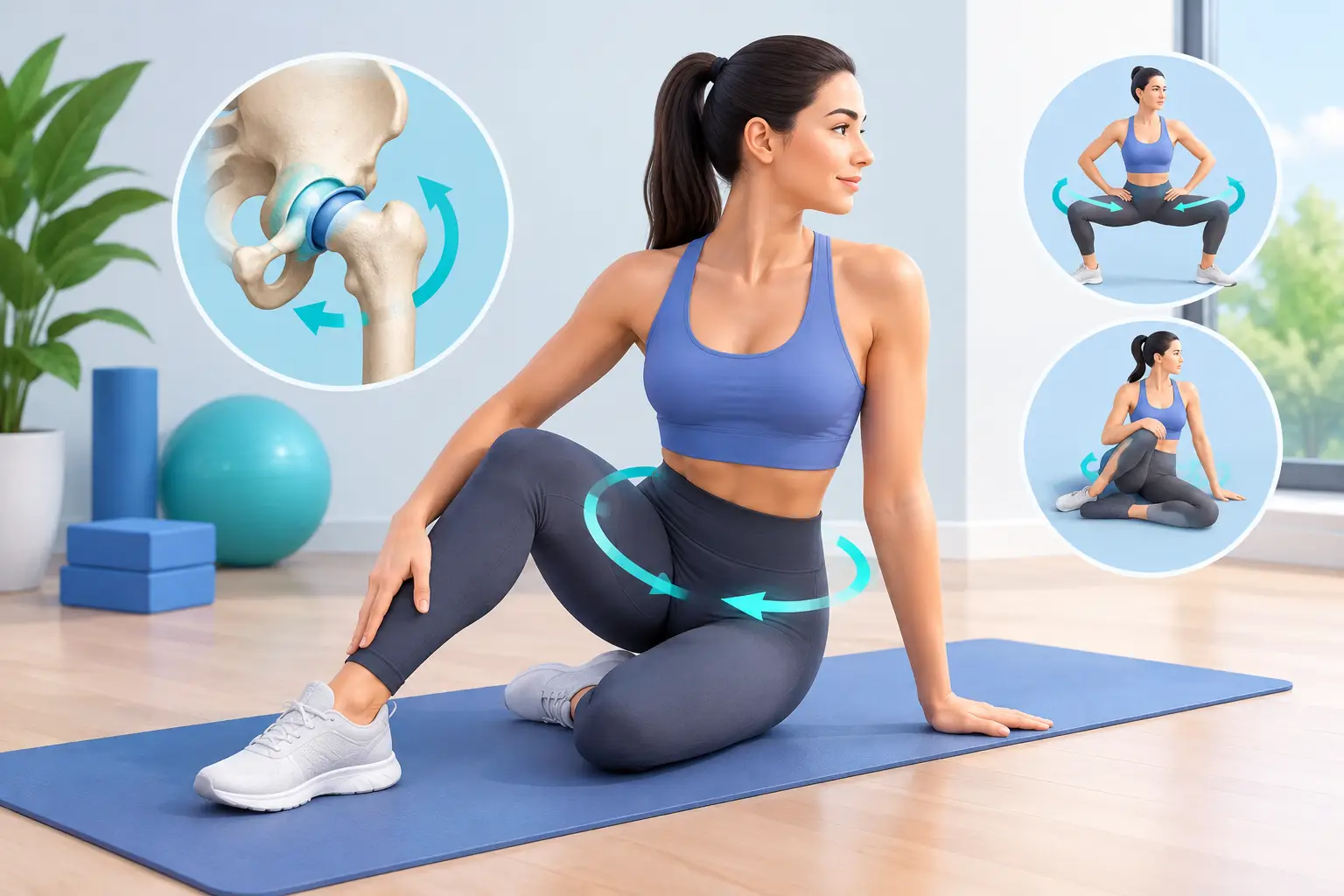
90/90 hip switches
Sit on the floor with both knees bent, one leg positioned in front of you and the other to the side. Keeping your torso as tall as you can, slowly rotate both knees from one side to the other. Use your hands behind you for support if needed.
This drill gives you a practical way to explore internal and external rotation without loading the hip heavily. Move slowly, stay out of painful pinching, and do not force your knees toward the floor. If sitting on the ground is uncomfortable, elevate your hips on a folded towel or yoga block.
Assisted hip rotation at the wall
Stand beside a wall or counter for balance. Shift most of your weight onto one leg, then gently rotate the other thigh inward and outward while the knee stays bent. Keep your pelvis relatively level and avoid turning the movement into a low-back twist.
This variation begins to connect hip rotation to standing, which is where many people need it. It also makes side-to-side differences easier to notice. Start with a small, controlled range and build from there.
Strengthen the range you gain
Mobility tends to be more useful when your body can control it under load. For example, a supported split squat, lateral step-down, single-leg balance reach, or light single-leg Romanian deadlift can train the hip, trunk, and foot to work together.
Choose a variation you can perform without a sharp increase in symptoms or a major compensation. If your knee consistently collapses inward, your pelvis drops, or your back takes over, reduce the range, use support, or lower the load. The right exercise is not the most advanced version. It is the version that challenges you while allowing clean, repeatable movement.
Do not ignore the rest of the chain
Hip rotation does not happen in isolation. Limited ankle motion may change how your foot and knee move in a squat. Poor trunk control may make it difficult to keep the pelvis steady during a lunge. A stiff upper back can even affect the rotational demands that show up at the hip during golf, tennis, or throwing.
This is also why foam rolling or stretching may provide temporary relief without changing the pattern that keeps returning. Passive work can be helpful when it makes movement feel easier, but it is rarely the whole plan. The follow-up matters: use the new range in a controlled movement, then gradually build strength and tolerance.
For someone returning to strength training, that progression might begin with a comfortable goblet squat and split squat, then move toward heavier bilateral and single-leg work. For a runner, it may include gradual mileage progression alongside single-leg strength and rotational control. For a golfer, it may involve hip and trunk rotation drills before progressing to more demanding swings. The details depend on what you want your body to do.
Know when a personalized assessment helps
If you have tried stretching and mobility videos for weeks without meaningful change, the missing piece may be measurement. A whole-body movement assessment can identify whether hip rotation is actually the priority or whether another limitation is changing how the hip is loaded.
At SYMYO Sports Therapy in Farmington Hills, the process looks beyond the painful area. A Movement & Performance Assessment combines mobility, balance, strength, core stability, posture, and movement-pattern testing to show what needs to improve first. Clear measurements make it easier to build a plan that progresses from reducing irritation to restoring motion and reinforcing it with strength.
The SYMYO Method follows that same sequence: Reduce, Restore, Reinforce. Hands-on treatment may help when it supports better movement, but the longer-term target is physical capacity. You should leave with a clearer understanding of what you can work on now, what to avoid temporarily, and how to progress back to the gym, the course, the trail, or the activities you enjoy.
Hip rotation is not a test you need to pass. It is one part of a body that needs enough motion, control, and strength for the life you want to keep living. Start with comfortable movement, earn more range through control, and give your body time to adapt.