Learn the best exercises for hip stability to improve control, build strength, and stay active with a smart progression for hips, knees, and back with more confidence.
A hip that feels weak, pinchy, or unreliable rarely needs more random stretching. If your knee caves in during a squat, your back takes over on a deadlift, or a long walk leaves one side of your hip irritated, your body may need better control through the hip. The best exercises for hip stability build that control progressively, so you can move better and get stronger without simply pushing through the same recurring limitation.
Hip stability is not about making the hip rigid. It is the ability to control the pelvis and upper leg while you walk, climb stairs, run, lift, rotate, and balance on one leg. Strong hip muscles matter, but timing, coordination, range of motion, and how the rest of your body contributes matter too.
For active adults, this is why one person may improve with simple band work while another needs to first address limited hip mobility, trunk control, ankle motion, or an old strength imbalance. The right exercise is the one that challenges your current capacity without causing you to compensate.
What hip stability should look like in real movement
Your hip is designed to move in several directions while keeping the pelvis reasonably controlled. During a single-leg stance, for example, the muscles on the outside and back of the hip help keep the pelvis from dropping excessively and guide the thigh so the knee can track well.
That does not mean every knee that moves inward is a problem, or that every sore hip is caused by weak glutes. Movement is variable, and pain can have several contributing factors. But if you repeatedly lose control, shift away from one side, or feel the same area flare up when activity increases, improving hip capacity may be a useful part of the plan.
The exercises below move from foundational control toward strength and single-leg function. Start with the versions you can perform with steady breathing, a controlled pace, and no sharp or escalating pain.
The best exercises for hip stability
1. Side-lying hip abduction
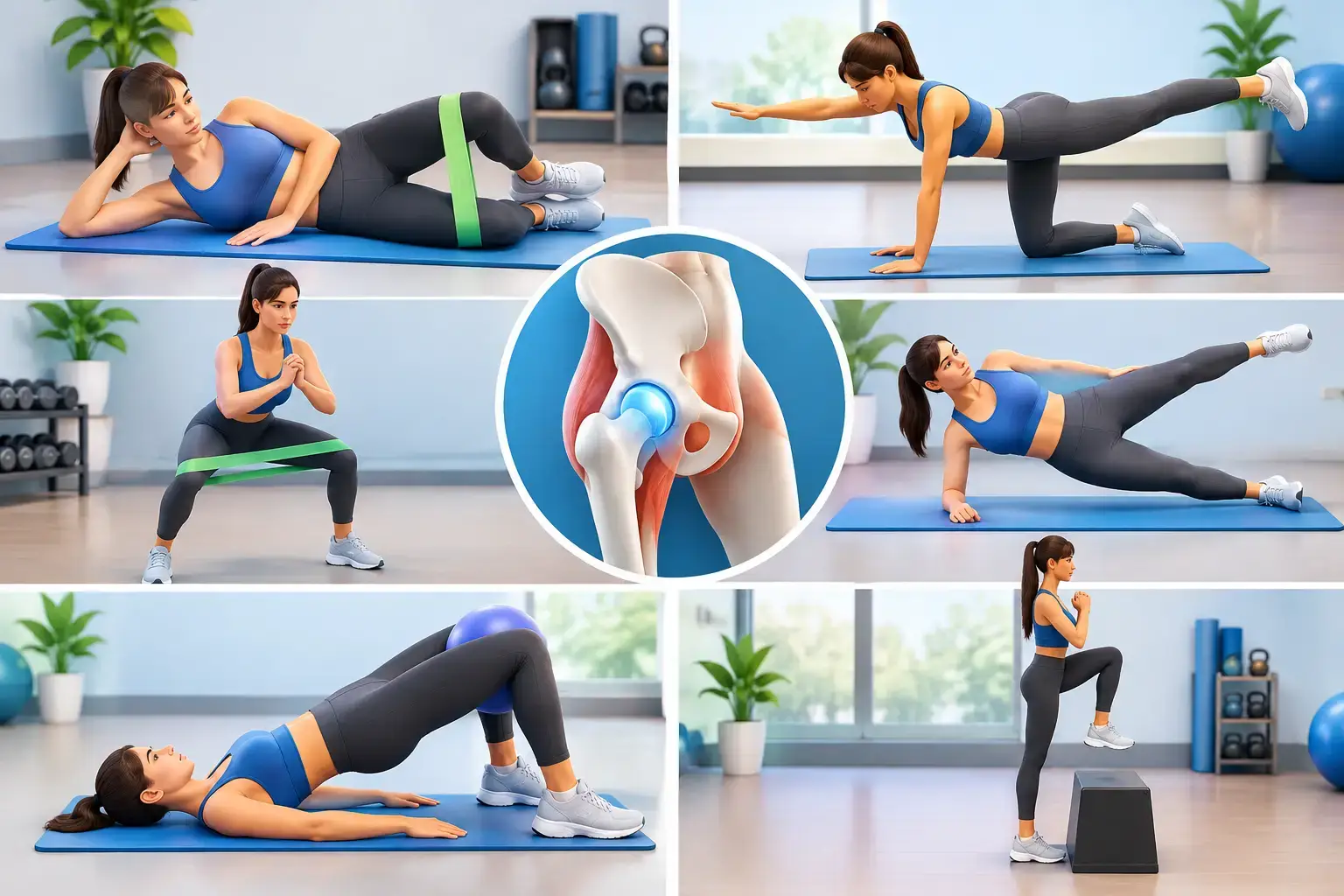
Lie on your side with your bottom knee bent and your top leg straight. Keep your pelvis stacked rather than rolling backward. Raise the top leg slowly, leading with the heel, then lower it with control.
This is a straightforward way to train the muscles on the outside of the hip without asking your balance to do too much at once. The common mistake is lifting the leg too high and tipping the pelvis back. A smaller, cleaner range is more useful than a high leg lift performed with momentum.
Try 2 to 3 sets of 8 to 15 controlled repetitions per side. If you feel this mostly in the front of the hip or low back, reduce the range and reset your position.
2. Glute bridge with a band
Place a light resistance band above your knees, lie on your back with knees bent, and press through your feet to lift your hips. Gently press your knees outward into the band while keeping your ribs and pelvis from flaring apart.
The bridge builds hip extension strength while the band adds an element of outward hip control. It is a good early option for people who feel unstable in squats or deadlifts but are not yet ready to load those patterns heavily.
Pause for one or two seconds at the top, then lower slowly. Perform 2 to 4 sets of 8 to 12 repetitions. You should feel your glutes working, not cramping in your hamstrings or arching through your low back.
3. Quadruped hip extension
Start on hands and knees, with hands under shoulders and knees under hips. Without shifting your weight side to side, extend one leg behind you until your thigh is roughly in line with your body. Return with control.
This exercise challenges the ability to use hip extension while the trunk and pelvis stay organized. It can be especially helpful for people who tend to create movement from their low back instead of their hip.
Keep the range modest. If your back arches or your pelvis rotates open, that is your signal to shorten the movement. Aim for 2 to 3 sets of 6 to 10 repetitions on each side.
4. Banded lateral walks
Place a loop band above your knees or around your ankles, depending on your current strength. Set into a shallow athletic stance, maintain tension on the band, and take slow steps to the side without letting your feet snap together.
Lateral walks train the hip to resist unwanted inward movement of the thigh during a functional standing position. They are useful before lower-body strength training, but they should not be the entire hip program. The goal is to prepare for stronger, more demanding movement.
Take 8 to 12 deliberate steps in each direction for 2 to 3 rounds. Keep your torso quiet and avoid rocking from side to side.
5. Supported single-leg balance
Stand near a wall, counter, or rack for light support. Shift your weight to one foot and lift the other foot just off the floor. Keep the standing knee soft and your pelvis level as you breathe normally.
Balance is not just a foot exercise. Single-leg standing asks the hip, trunk, and foot to work together. It also gives you immediate feedback: do you grip with your toes, lean your torso, lock the knee, or feel your pelvis drop?
Start with 15 to 30 seconds per side for 2 to 3 rounds. Progress by reducing hand support, turning your head slowly, or adding a controlled reach with the free leg. Closing your eyes is not automatically a better progression if it turns the drill into a guessing game.
6. Step-downs
Stand on a low step or box with one foot near the edge. Slowly bend the standing leg and tap the opposite heel to the floor, then press back up. Use a wall or rail for support if needed.
Step-downs build the kind of hip and knee control needed for stairs, hills, running, and changing direction. Watch the whole pattern, not just the knee. Your knee can travel forward, but the movement should stay controlled rather than collapsing inward or shifting heavily to one side.
Begin with a low step and 2 to 3 sets of 6 to 10 repetitions per side. Increase step height only when you can lower and rise without losing control.
7. Split squats
Set up in a staggered stance and lower your back knee toward the floor as both knees bend. Keep your front foot fully planted and allow your torso to stay slightly forward if that helps you load the front hip comfortably.
A split squat is one of the most practical ways to develop single-leg strength without the full balance demand of a single-leg squat. It challenges the hips through a meaningful range and often exposes side-to-side differences in mobility, strength, or confidence.
Use body weight or hold onto support at first. Perform 2 to 4 sets of 6 to 10 repetitions per side. Add load only when the movement is steady and your symptoms remain manageable during and after training.
8. Single-leg Romanian deadlift
Stand on one leg with a slight bend in the knee. Reach the other leg behind you as your torso tips forward from the hip, then press through the standing foot to return to tall standing. Start with fingertips on a wall or rack if balance limits the exercise.
This movement combines hip strength, balance, trunk control, and foot stability. It is valuable for golfers, runners, gym-goers, and anyone who wants to maintain confidence in single-leg movement. It also requires more coordination than the earlier exercises, so it is not always the right starting point.
Keep your hips as level as possible and move slowly enough to notice where you lose position. Begin with 2 to 3 sets of 5 to 8 repetitions per side, then add a dumbbell or kettlebell as control improves.
How to choose the right starting point
Do not assume the hardest exercise is the best one. If lateral walks create hip discomfort, a bridge or side-lying exercise may be a better entry point. If bridges feel easy but stairs still expose poor control, step-downs or split squats may provide the more relevant challenge.
Use quality as your measurement. You should be able to breathe, keep a controlled pace, and repeat the movement without major compensation. Mild muscular effort is expected. Sharp pain, increasing joint pain, numbness, giving way, or symptoms that remain significantly worse after exercise are reasons to stop and get individualized guidance.
A useful progression is to first improve awareness and control, then add range of motion, resistance, and more demanding single-leg tasks. This mirrors the SYMYO Method: Reduce what is aggravating the issue, Restore the mobility and movement options you need, then Reinforce them with progressive strength and capacity training.
When hip exercises are not enough
If the same hip, knee, or back issue returns every time you increase activity, the answer may not be another exercise from a generic list. Your hip control may be one factor, but limitations elsewhere in the body, training volume, recovery, or how you move under load can also matter.
A whole-body movement assessment can help identify what needs to improve first. At SYMYO Sports Therapy in Farmington Hills, that process looks at mobility, balance, strength, core stability, and movement patterns to create a clearer plan than simply treating the spot that hurts.
The most useful hip stability program is one you can progress. Start where you can control the movement, train consistently, and let better movement earn more load, speed, and complexity over time.