Lower Back Pain · Exercise Form
How to Glute Bridge Without Back Pain: 2 Simple Tips
By Dr. Mitch Israel·Updated September 30, 2026
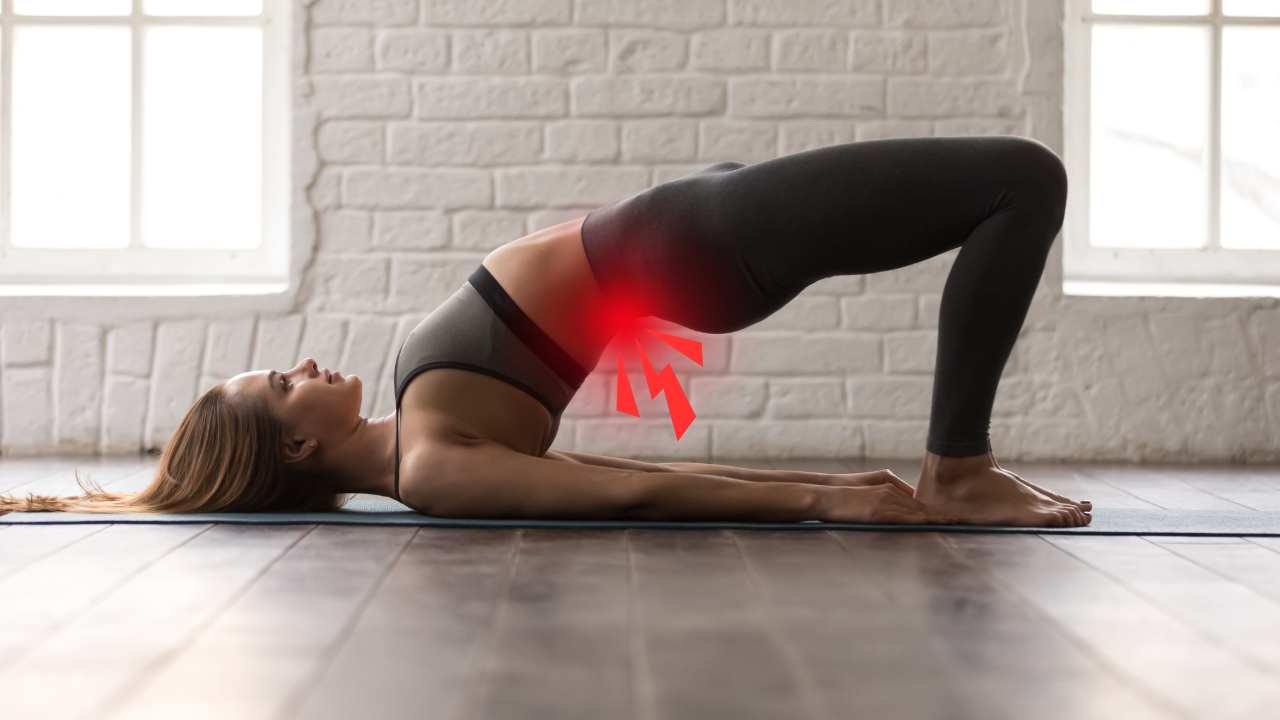
Are you trying to strengthen your glutes, but every time you do a glute bridge you feel it more in your lower back?
Before you give up on the exercise, there are a couple of simple things I want you to try.
I'm Dr. Mitch Israel, and I own SYMYO Sports Therapy here in Farmington Hills. I work with active adults who want to keep exercising but have a nagging issue that keeps getting in the way.
One thing I see all the time is people assuming an exercise is “bad” for them because it hurts.
Sometimes we need to choose something different. But sometimes a small change in how you do the exercise can make a huge difference.
The glute bridge is a great example.
If you feel it mostly in your lower back instead of your glutes, here are the first two things I would try.
Watch: How to Glute Bridge Without Back Pain
Tip 1: Start With Better Rib Cage and Pelvis Alignment
One of the most common things I see when someone's lower back bothers them during a glute bridge is that they get too much movement from their back instead of their hips.
As they lift, their ribs flare, their pelvis tips forward, and their lower back starts to arch.
Then they keep trying to lift their hips higher. At that point, the glute bridge is turning into a backbend.
Instead of worrying about how high you can bridge, first clean up your starting position.
Here's how:
- Lie on your back with your knees bent and feet flat on the floor.
- Gently tilt your pelvis so your lower back moves closer to the ground.
- Exhale slightly and bring your rib cage down toward your pelvis.
- Try to keep that position as you lift.
From there, press your feet into the ground and raise your hips.
Only go as high as you can without losing that position.
If you have to flare your ribs and arch your lower back to get another couple of inches, those extra inches are not helping you.
You should feel your glutes doing most of the work.
Don't Worry About Making the Bridge as High as Possible
People often drive as hard as they can through their heels and try to get their hips as high as possible.
Higher is not necessarily better.
I would rather see a slightly smaller bridge where your glutes do the work than a huge bridge where the extra movement comes from your lower back.
Control the range you have first. Then build from there.
What If Your Back Still Hurts?
If that first change fixes it, great. Sometimes that is all you need.
If your lower back is still taking over, try one more variation.
Tip 2: Try the Knee-Hug Bridge
This is one of my favorite ways to teach someone what a better bridge position should feel like.
Here's how:
- Lie on your back and hug one knee toward your chest.
- Keep your lower back comfortably against the floor.
- Press the opposite foot into the ground.
- Lift your hips while continuing to hold the other knee toward your chest.
- Perform five or six controlled reps, then switch sides.
Holding one knee toward your chest makes it much harder to get extra movement from your lower back.
That gives you a chance to feel what it is like to extend through the hip and use the glute on the working side.
After a few reps on each side, return to your normal two-leg bridge and recreate that same feeling.
Keep your ribs and pelvis controlled, squeeze your glutes, and stop before your lower back starts taking over.
How to Progress the Glute Bridge
Once you can do a bodyweight bridge comfortably and feel your glutes working, you can make it harder.
Add resistance while keeping the same basic principles.
Keep your rib cage and pelvis controlled.
Use the range you can control.
Do not sacrifice your position just to lift more weight or get higher.
The same idea applies when you progress to weighted bridges or hip thrusts. Get good at the movement first. Then load it.
What If These Changes Don't Fix Your Back Pain?
This is where things become more individual.
Sometimes one small change really does solve the problem. If this article helps you bridge without pain again, awesome.
But there is a limit to what I can figure out through an article or video.
I do not know how your hips move, how your back responds to different movements, how strong you are, or whether you are actually missing mobility.
I also do not know if the bridge is the only thing that bothers you—or if your back acts up when you squat, lift, golf, sit too long, or work out.
That is where working with me directly becomes different.
Instead of guessing which exercise, stretch, or treatment you need, I can assess how your body moves, determine what deserves attention, and build a plan around you.
Try these changes first. If they work, keep going. If your back continues to get in the way of being active, that is when I would recommend taking a closer look.
Common Questions
Why does my lower back hurt during glute bridges?
One common reason is that you are getting too much movement from your lower back instead of your hips. If your ribs flare and your pelvis tips forward as you lift, your lower back starts to arch. Try controlling your rib cage and pelvis and only lifting as high as you can while maintaining that position. Not everyone’s pain happens for the same reason, so it is worth looking deeper if changing your technique does not help.
How high should I lift during a glute bridge?
Only lift as high as you can while maintaining good control. A slightly smaller range that uses your glutes is more useful than a bigger range that requires you to arch your lower back.
Should I stop doing glute bridges if they hurt my back?
Not necessarily. First try modifying your technique or using the knee-hug variation. If the pain persists, gets worse, or you experience pain traveling into your leg, numbness, or tingling, stop pushing through it and have it evaluated.
Are glute bridges good for lower back pain?
They can be useful for some people, but no single exercise is a universal back-pain exercise. Whether a glute bridge makes sense depends on what is going on and what your body needs.
Where can I get help with lower back pain near Farmington Hills?
SYMYO Sports Therapy works with active adults in Farmington Hills who are dealing with back pain and other nagging issues that make it harder to exercise and stay active. We start by figuring out what is going on and what your body needs.
Still Dealing With Lower Back Pain?
If you have tried changing your form, stretching, strengthening, resting, or bouncing between exercises and your back still gets in the way, you probably do not need another random exercise.
You need to figure out what your body needs.
During the SYMYO Back Pain Assessment, I look at how your spine and hips move, your strength and control, and how your body handles different movements.
Then I explain what stands out, what matters, and what I recommend you work on next.
No generic back pain program. No guessing. A plan based on you.
Learn More About the Back Pain AssessmentAbout Dr. Mitch Israel
I'm Dr. Mitch Israel, a sports chiropractor and rehab specialist and the owner of SYMYO Sports Therapy in Farmington Hills, Michigan.
I created SYMYO to help people do more than temporarily feel better.
My goal is to help you understand your body, improve what actually needs improving, and build the strength and confidence to keep doing the things you enjoy.
I share articles and videos like this because I want people to have better information about pain, movement, exercise, and physical health.
When general advice is not enough, a personalized assessment and plan can make the difference.
SYMYO Sports Therapy
33930 West 8 Mile Road, Suite 2AFarmington Hills, MI 48335
Serving Farmington Hills, Novi, Northville, Livonia, Plymouth, West Bloomfield, Farmington, and surrounding Metro Detroit.