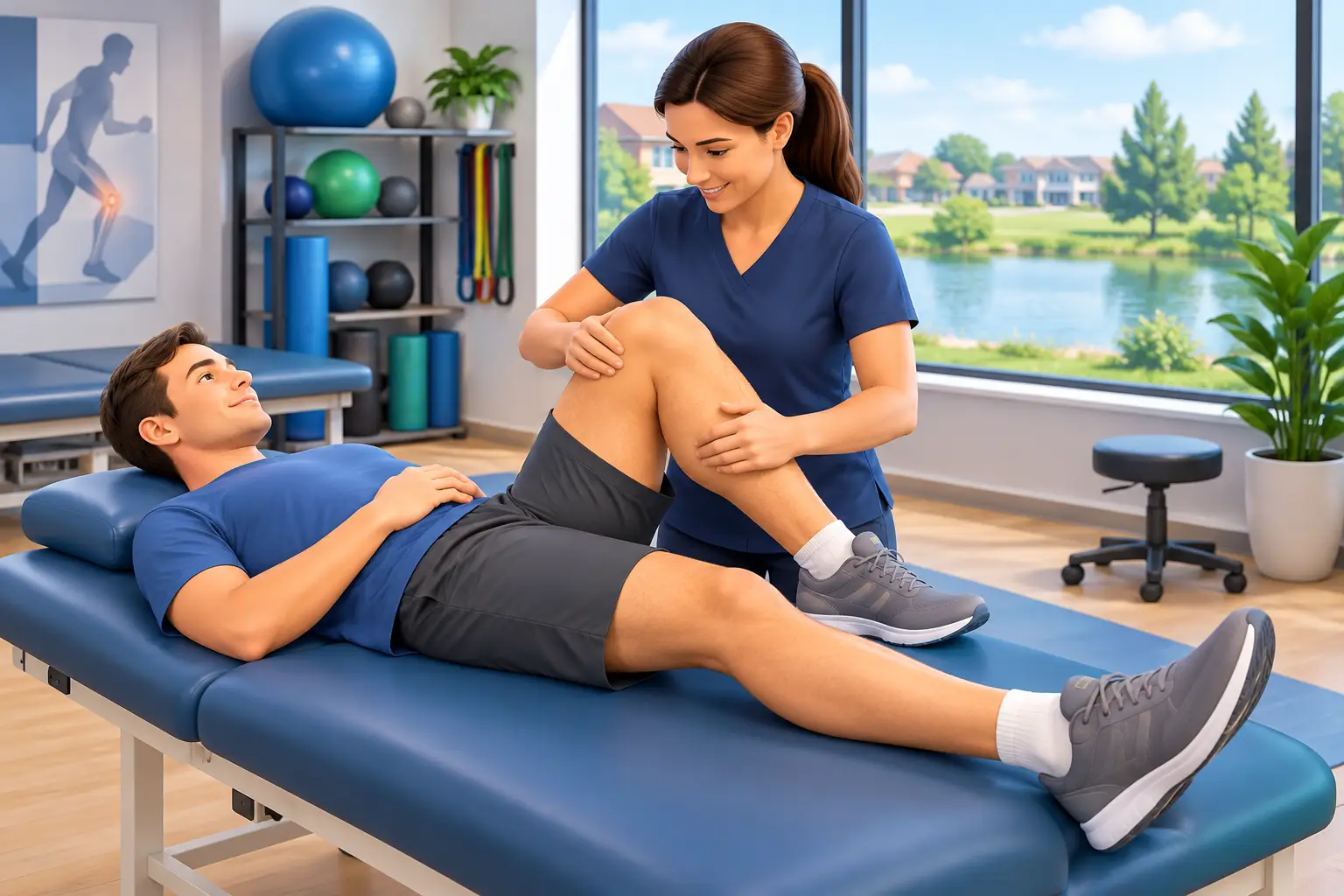
Looking for the best knee rehab in Farmington Hills? Learn what a complete plan should assess, how progress is measured, and when strength matters most.
That first descent down the stairs can tell you a lot about your knee. Maybe it feels stiff after a long drive, aches after pickleball, or swells after a run you used to handle easily. If you are searching for the best knee rehab Farmington Hills has to offer, the real question is not simply who can make the knee feel better today. It is who can help you understand what may be contributing to the problem, rebuild capacity, and return to the activities that matter to you.
For active adults, knee pain is rarely just an inconvenience. It changes how confidently you squat, climb stairs, golf, train, run, or get down on the floor with your kids. Good rehabilitation should meet that reality with a clear process, not generic exercises or a passive treatment plan with no progression.
What the Best Knee Rehab in Farmington Hills Should Assess
A knee is part of a system. It needs to tolerate force from the ground up and from the hips and trunk down. That does not mean every knee problem begins at the hip, foot, or back. It does mean that treating the painful spot alone can miss useful information about why certain movements continue to be difficult.
A thorough assessment should begin with your story. When did symptoms start? Was there a clear injury, a gradual buildup, a recent change in training, or a recurring issue that never fully settled down? Your goals matter, too. Rehabilitation for someone who wants to walk comfortably is different from rehabilitation for someone preparing to return to tennis, skiing, strength training, or weekend running.
From there, the evaluation should look at how you move, not just where you hurt. Useful measurements may include knee range of motion, hip and ankle mobility, balance, single-leg control, squat and step-down mechanics, strength, core stability, and how your body responds to load. If a movement is limited or painful, the next step is to identify what needs to improve first.
This is where clear measurements help. Rather than guessing whether you are “better,” you can track changes in strength, movement quality, tolerance for stairs, training volume, and the specific activities that previously caused symptoms.
Pain location is only one piece of the picture
Pain at the front of the knee, around the kneecap, on the inside of the joint, or behind the knee can have different patterns and considerations. Symptoms alone cannot confirm a diagnosis. But they can guide a more focused examination and help determine whether rehabilitation is appropriate or whether you need additional medical evaluation.
New inability to bear weight, a visibly deformed joint, significant swelling after trauma, fever, a locked knee, or calf swelling should be evaluated promptly by an appropriate medical professional. For many non-emergency knee complaints, a movement-based assessment can provide a practical starting point for understanding current limitations and building a plan.
Rehab Should Move Beyond Passive Relief
Hands-on treatment and sports chiropractic care may help reduce discomfort or improve motion for some people. That can be valuable, especially when pain or stiffness is making it hard to begin exercising. But passive care alone does not prepare a knee for the demands of hiking, lunging, changing direction, lifting, or playing a full round of golf.
The stronger approach is to use symptom relief as an entry point, then build toward active rehabilitation. At SYMYO Sports Therapy, this follows the Reduce, Restore, Reinforce method. First, reduce the barriers that are keeping you from moving well. Then restore the mobility, control, and strength that may be limited. Finally, reinforce those improvements with progressive loading that matches your real-life goals.
That progression matters because feeling better and being ready are not always the same thing. A knee may be less painful after a few visits, yet still lack the strength or confidence required for a long walk, a heavy lower-body workout, or a quick change of direction on the court.
What a Complete Knee Rehab Plan Includes
The exact plan depends on your history, current capacity, and goals. Someone recovering from a recent flare-up may need a different starting point than someone who has avoided squatting for two years. Still, complete knee rehab usually includes several connected phases.
Early on, the focus may be on finding movements you can tolerate and improving motion that has become restricted. This is not about forcing through sharp pain. It is about establishing a workable baseline and giving the knee an appropriate amount of movement and load.
Next comes control and stability. Exercises may involve supported single-leg work, step patterns, balance, controlled knee bending, and hip or trunk training. The goal is not to chase a perfect-looking movement. The goal is to improve your ability to control the positions and tasks you need in daily life and exercise.
Strength becomes increasingly important as symptoms settle and tolerance improves. The quadriceps, hamstrings, glutes, calves, and trunk all contribute to how you absorb and produce force. A program should progressively challenge these areas through exercises that fit your current ability, whether that means a sit-to-stand, split squat, step-up, sled work, deadlift variation, or loaded carry.
Finally, rehab should include a return-to-activity phase. If running is the goal, you need a gradual running progression. If you want to play pickleball, your plan should eventually include lateral movement, deceleration, and repeated efforts. If you want to lift, you need to practice progressively loaded versions of the lifts that matter to you. General exercise has value, but task-specific preparation is what makes a return to activity more realistic.
Look for Progressions, Not a Fixed Exercise Sheet
A printed list of band exercises can be a starting point, but it is not a complete plan. The best knee rehab adapts as your body responds. Some weeks, the right decision is to increase load. Other weeks, the better move is to adjust range of motion, reduce volume, or spend more time on recovery and technique.
Progression should be based on more than pain alone. Consider whether swelling is changing, whether stairs are easier, whether you can tolerate more training, and whether strength and movement measures are improving. A good provider explains these decisions so you know why an exercise is being added, changed, or removed.
This approach also avoids the common trap of resting indefinitely. Rest can be useful after an acute flare-up or injury, but long-term avoidance often leaves people less prepared for the activities they want to resume. Appropriate loading is usually part of rebuilding physical capacity.
Questions to Ask Before Choosing a Provider
Before committing to knee rehabilitation, ask how the initial assessment works and whether it includes a whole-body movement evaluation. Ask how progress will be measured, how your exercise plan will change over time, and how treatment connects to your specific goals.
You should also ask who will guide your care. Consistent communication matters. You want to understand what the findings mean, what you should work on at home, and what signs indicate that you are ready for more activity.
For active adults in Farmington Hills, it is reasonable to expect more than a plan designed only to calm symptoms. A strong rehabilitation experience should give you a clearer picture of your body, practical next steps, and a path toward being more capable than you were when you started.
The Goal Is Confidence Under Load
The right knee rehab is not defined by one exercise, one treatment technique, or the fastest promise. It is defined by whether the plan helps you move better, get stronger, and trust your body again during the activities you value.
Your knee does not need a generic routine. It needs an honest assessment of where you are now, a progressive plan for what needs to improve first, and enough support to keep moving forward when the process is not perfectly linear. That is how rehabilitation becomes more than relief - it becomes a return to an active life with greater confidence.