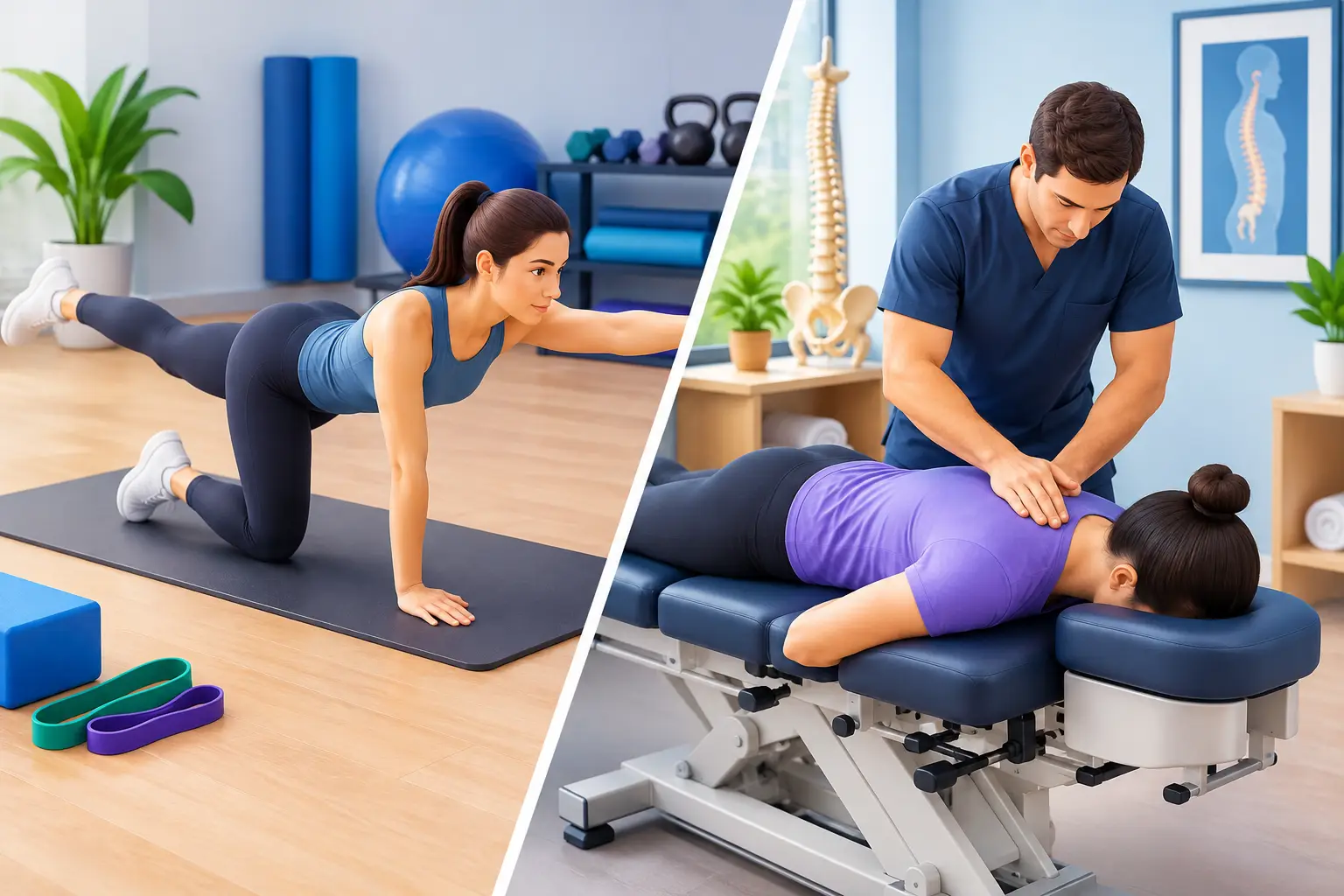
Corrective exercise versus chiropractic care: learn when each approach helps active adults reduce pain, move better, build strength, and return to activity
What Corrective Exercise Is Designed to Do
Corrective exercise is not a random set of stretches or a collection of social-media drills. It is a targeted exercise plan based on how your body currently moves, where you have restrictions, and what your activities require.
For example, someone with recurring knee discomfort while running may have limited ankle motion, reduced single-leg control, or a recent drop in hip and calf strength. None of those findings automatically explains the pain. They may, however, be factors worth addressing because they can affect how the body manages running volume and force.
A well-designed corrective exercise program may include mobility work, balance drills, core stability, controlled strength exercises, and a gradual return to more demanding movements. The goal is not to perform “perfect” movement. It is to improve the physical qualities that help you move better and get stronger for your specific life.
Corrective exercise is especially valuable when your main issue is not severe pain, but a recurring limitation. Maybe you can exercise, but deep squats feel restricted. Maybe your shoulder works for daily tasks but becomes unreliable during tennis or overhead lifting. Exercise gives you a way to practice a better option repeatedly and build capacity over time.
What It Requires
Exercise is active care. Progress depends on selecting the right starting point, doing the work consistently, and progressing it as your ability changes. A band exercise that felt useful six weeks ago may no longer be challenging enough to create a meaningful adaptation.
That is also why generic corrective programs can fall short. Two people may both report hip pain, yet one may need improved hip strength while another first needs a more comfortable range of motion, a change in training load, or a different strategy for the way they hinge and squat.
What Sports Chiropractic Care Can Add
Sports chiropractic care should be more than a quick visit focused only on the painful area. In a rehabilitation-centered setting, it is one part of a larger plan to assess the whole body, reduce symptoms that limit movement, and help you return to activity with a clear progression.
Hands-on treatment may be used to help decrease sensitivity, improve comfort with movement, or address areas of stiffness that are making exercise difficult. Depending on the person and their needs, care may also involve soft-tissue work, guided mobility, rehabilitation, movement coaching, and training modifications.
This can be particularly helpful when pain is making it hard to start exercising effectively. If bending, rotating, reaching, or loading a leg feels too uncomfortable, telling someone to simply strengthen through it is not always useful. The first step may be to reduce the immediate barrier, then reintroduce movement in a way the body can tolerate.
Sports chiropractic care also provides clinical decision-making. A thorough provider can examine your history, training demands, mobility, strength, and movement patterns to determine what needs attention first. They can also recognize when symptoms need evaluation by another medical professional rather than more exercise or hands-on treatment.
The Limit of Passive Care Alone
Passive treatment can be helpful, but it does not replace the need to build strength, coordination, and tolerance for activity. Feeling looser after a session is valuable if it helps you move. It is less useful if nothing changes between visits.
Consider an active adult whose low back feels better after treatment but flares again whenever they return to deadlifts, yard work, or long car rides. Treatment may reduce symptoms enough to make movement possible. Yet the longer-term plan still needs to explore loading tolerance, hip and trunk strength, movement options, recovery, and how quickly activity volume is increasing.
Corrective Exercise Versus Chiropractic Care: When Each Fits
Corrective exercise tends to be the primary focus when you can move with manageable symptoms and need to improve a specific physical quality over time. This may include rebuilding strength after an injury, improving balance and control, restoring confidence with a movement, or preparing for a return to running, golf, lifting, or recreational sports.
Chiropractic care may have a larger early role when pain, stiffness, or guarding is making normal movement and exercise difficult. It can help create a more usable starting point, especially when combined with an assessment that looks beyond the immediate pain site.
The distinction is not always clean. Someone recovering from a shoulder issue may benefit from hands-on treatment to make reaching more comfortable while also using progressive exercise to rebuild rotator cuff and upper-back strength. Someone with recurring hip tightness may need coaching on squat mechanics, strength work, and temporary changes to training volume, with hands-on care used selectively along the way.
The key question is not, “Which one is better?” It is, “What does my body need now, and what will help me continue progressing?”
Why Assessment Changes the Plan
Pain location does not always tell the full story. A painful knee deserves attention, but so do the ankle, hip, trunk, training history, and movement demands that may influence how the knee is being loaded. The same principle applies to the neck, shoulder, back, and other common problem areas.
At SYMYO Sports Therapy, the process starts by measuring rather than guessing. A Movement & Performance Assessment looks at posture, mobility, balance, strength, core stability, and movement patterns using physical testing and AI-assisted movement analysis. The goal is to identify clear priorities: what is doing well, what may be limiting you, and what needs to improve first.
This matters because more exercise is not automatically better. If someone has been stretching a tight area for months without change, the missing piece may be strength, control, or a training adjustment. If someone has avoided exercise because of pain, the right first step may be a scaled version of the movement rather than complete rest or an aggressive workout.
Clear measurements also make progress easier to see. Instead of relying only on whether you felt better that day, you can track changes in range of motion, strength, balance, movement confidence, and the activities you can tolerate.
A Better Model: Reduce, Restore, Reinforce
For active adults, the most useful comparison is often not corrective exercise versus chiropractic care, but how they work together. A process-led plan can follow three practical stages.
First, reduce the pain, stiffness, or irritation that is limiting your ability to move. This may include hands-on treatment, activity modifications, and movements selected to stay within a tolerable range.
Next, restore the mobility, stability, and movement options needed for your goals. This is where specific rehabilitation and corrective exercise become central. You are not just chasing a sensation of looseness. You are regaining usable motion and control.
Then reinforce those improvements with progressive strength training and a return to the activities that matter to you. A runner needs more than pain-free walking. A golfer needs rotational control and endurance. A gym-goer needs the capacity to squat, hinge, push, pull, and recover from training.
These stages can overlap, and progress is not always linear. A demanding work week, a new sport season, poor sleep, or a sudden jump in training can temporarily change what your body tolerates. A good plan adjusts without losing sight of the larger goal.
How to Choose the Right Starting Point
Start with an evaluation if pain has persisted, keeps returning, changes how you move, or prevents you from exercising the way you want. You should also seek timely medical evaluation for severe symptoms, major trauma, progressive weakness, numbness, unexplained fever, or changes in bowel or bladder function.
For more common activity-related aches and limitations, look for care that includes both assessment and a plan. Ask whether you will learn what is being measured, why an exercise is being prescribed, and how your program will progress when it becomes easier. Those answers tell you whether the focus is building physical capacity or simply managing the next flare-up.
The goal is not to choose a side between treatment and exercise. It is to use the right support to get moving, then build the strength and confidence to stay moving. When your plan is based on clear measurements and progresses with your goals, you have a better path back to the gym, the course, the trail, or simply a more capable everyday life.