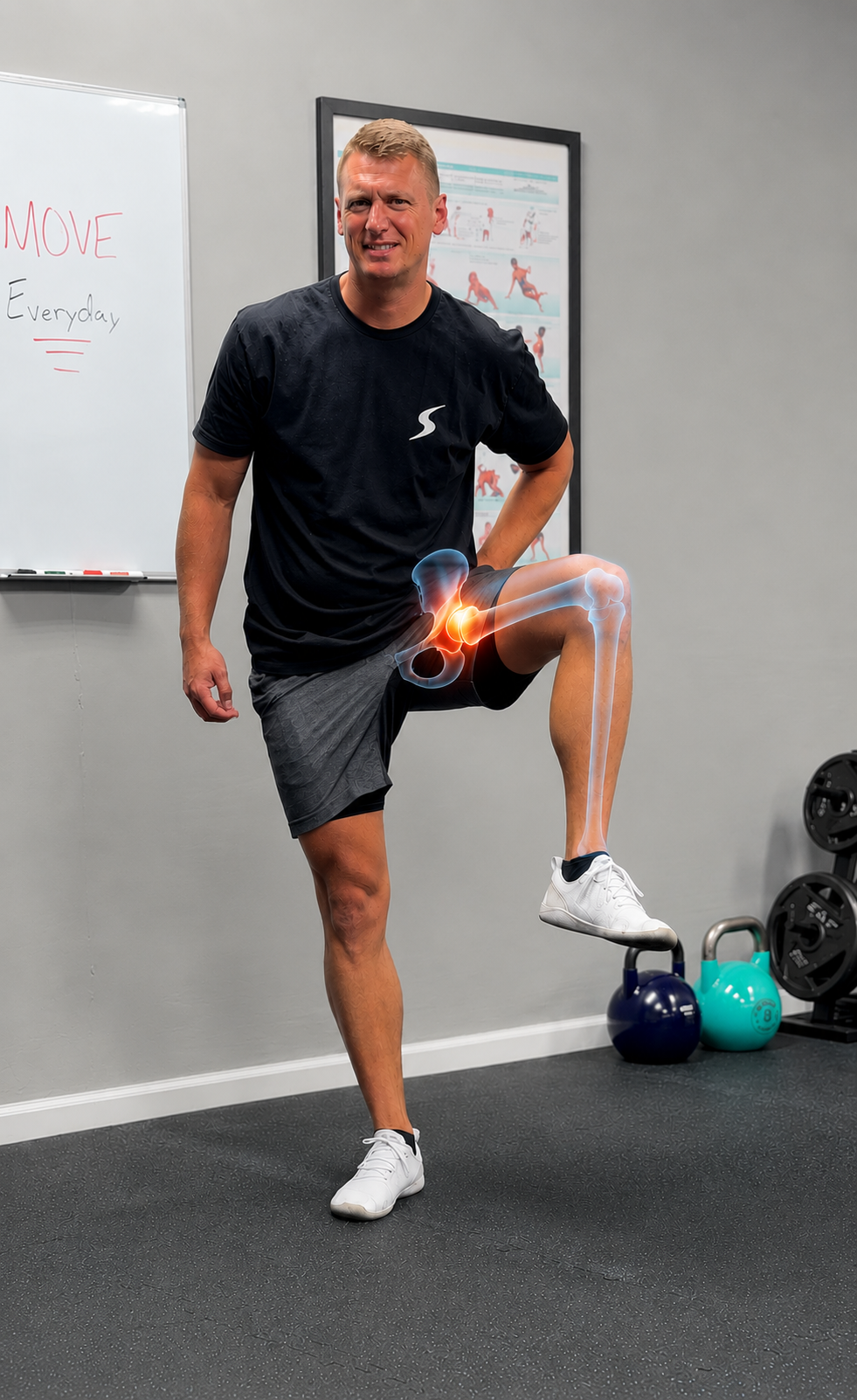
Hip Pain & Mobility

Tight Hips? Hip Pain? There's Usually More Going On Than You Think.

Hip pain and tightness are often signs that mobility, control, strength, or compensation patterns need to be measured. SYMYO helps active adults in Farmington Hills and Metro Detroit understand what their hips are really doing.

Inside SYMYO

Measure How Your Hips Affect the Whole Body

Real movement data, hands-on care, and a plan built around what your body actually needs.

Hip hinge and lower-body control assessment at SYMYO
Assessment-Led CareSYMYO

Why Hip Mobility Matters

Your hips sit between your trunk and legs, so they influence almost every athletic and daily movement. When hip motion is limited, your body usually finds movement somewhere else.

That extra motion often comes from the lower back, knees, or feet, which can create pain and performance limits over time.

How Hip Restrictions Affect

  • Lower back
  • Knees
  • Golf swing
  • Running
  • Squatting

Common Signs Your Hips Are Limiting You

  • You feel tight even after stretching.
  • Your lower back works during squats, deadlifts, or golf rotation.
  • Your knees cave, ache, or feel overloaded with activity.
  • You avoid deep positions because they feel blocked or pinchy.
  • Your stride, swing, or lifting mechanics feel uneven side to side.

How We Measure Hip Function

The AI Movement Assessment helps us see how your hips behave during full-body movement.

Movement Age® gives a broader score for how your body functions compared to your actual age.

Hip mobility testing shows whether you have the range you need, while compensation analysis shows where your body is working around the limitation.

The SYMYO System

A Hip Plan That Moves Beyond Stretching

01

Measure

Measure hip mobility, rotation, strength, balance, and full-body movement patterns before guessing at the plan.

02

Understand

Connect hip findings to the way you squat, hinge, rotate, walk, run, swing, or compensate through the back and knees.

03

Improve

Build mobility, control, and strength through better ranges of motion so the change carries into activity.

Why Treating Only the Hip Often Is Not Enough

Hip pain can be the loudest signal, but it may be tied to how your pelvis, trunk, knees, ankles, and feet coordinate movement. If those pieces are not measured, the same hip restriction can keep returning.

That is why hip pain care at SYMYO connects to sports therapy, the Movement & Performance Evaluation, and a personalized rehab plan.

What the Movement Assessment Looks At

  • Hip rotation, flexion, extension, and side-to-side differences.
  • Squat, hinge, balance, and single-leg control.
  • How the lower back and knees compensate when the hips are limited.
  • Strength through the ranges you need for training, sport, and daily life.

Who Benefits Most

For Active Adults Who Need Their Hips to Work Better

  • You feel stiff or pinchy through one or both hips.
  • Your back or knees compensate during training or sport.
  • You want better rotation for golf performance.
  • You struggle with running, squatting, lunging, or getting low.
  • You want a measurable plan instead of random stretching.

FAQ

Hip Pain & Mobility FAQ

Can tight hips cause lower back or knee pain?+

Yes. When the hips do not move well, the lower back or knees often pick up extra stress during walking, lifting, running, squatting, or sport.

Is hip mobility just about stretching?+

No. Hip mobility also depends on control, strength, joint position, and whether your body can use available range of motion under load.

How does SYMYO measure hip function?+

SYMYO uses AI Movement Assessment, Movement Age®, hip mobility testing, strength testing, and compensation pattern analysis to understand how your hips affect the rest of your body.

Why does hip pain keep coming back after stretching?+

Stretching may temporarily change how the hip feels, but recurring hip pain can return when strength, control, pelvic position, or compensation patterns are not addressed.

How does hip mobility influence Movement Age®?+

Hip mobility affects squatting, hinging, walking, rotation, and balance. Because the hips influence so many full-body movements, limited hip motion can contribute to a higher Movement Age® score.

What does a hip pain rehab plan include at SYMYO?+

A plan may include hip mobility work, movement control, strength training, hands-on care, and progression back to lifting, running, golf, or daily activity based on your assessment findings.

Should I start with the discovery page or the assessment?+

Start with the discovery page if you want to understand how the SYMYO process works before deciding whether the Movement & Performance Evaluation is the right next step.

Find Out What's Actually Limiting Your Hips