Posture · Mobility
Rib Flare: What It Is and Exercises to Improve It
By Dr. Mitch Israel·Updated September 30, 2026
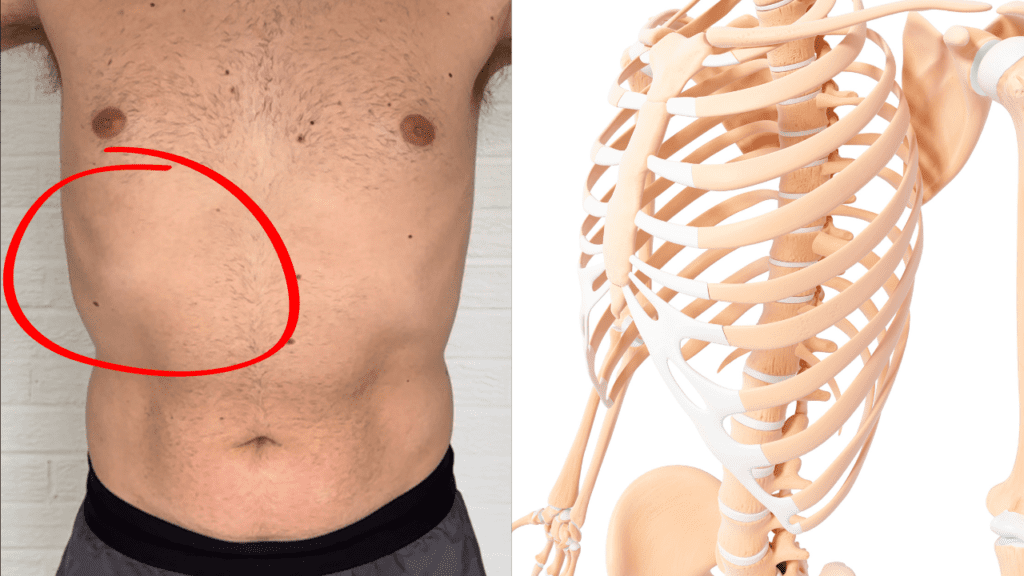
Have you noticed that your lower ribs seem to stick out, especially when standing, lying on your back, or reaching overhead?
That is commonly called rib flare.
You may have seen advice telling you to pull your ribs down, strengthen your core, or fix your posture. But seeing your ribs stick out does not automatically mean something is wrong.
I'm Dr. Mitch Israel, and I own SYMYO Sports Therapy here in Farmington Hills. I help active adults understand how their bodies move and what actually deserves attention.
Rib position can tell us something about how your trunk, pelvis, breathing, and shoulders work together. But you do not need to force your ribs into a “perfect” position all day.
Let's look at what rib flare is, why you may notice it, and a few ways to improve your control in these positions.
Watch: How to Improve Rib Flare
Is Pain, Stiffness, or Limited Mobility Keeping You From Being as Active as You Want?
If the way your body moves keeps getting in the way of working out, lifting, golfing, or being as active as you want, tell me what has been going on. I'll review it and let you know if SYMYO may be able to help.
What Is Rib Flare?
Rib flare is a term used when the lower ribs appear to stick forward or upward.
You may notice it while standing, lying down, reaching overhead, lifting weights, or doing certain exercises.
Sometimes this is simply how someone's body is built. Other times, rib position changes with breathing, pelvis and trunk position, or movement through the shoulders and spine.
That is why I want to know what happens when you move instead of deciding that your ribs need to be fixed.
Why Do Your Ribs Flare?
There is no universal cause.
Your anatomy and breathing matter. The position of your pelvis and spine can change how your rib cage sits. Your ribs may also lift when your body is trying to find extra movement somewhere else.
A common example is reaching overhead. If overhead movement is limited or hard to control, you may arch your lower back and lift your ribs to get your arms higher.
That does not automatically make your ribs the problem. Your body may simply be finding another way to complete the movement.
Is Rib Flare Bad?
Not necessarily. There is no single perfect posture everyone needs to hold all day.
I care more when rib position connects with something you cannot do comfortably—such as reaching overhead, lifting, or controlling your trunk during exercise.
Then it becomes useful information instead of something to fix because of how it looks.
A Simple Test: Reach Your Arms Overhead
Lie on your back with your knees bent and feet on the floor. Start with your arms by your sides and slowly reach overhead.
Notice whether your arms move comfortably, your lower ribs lift, your lower back arches far from the floor, or you have to force the movement.
This is not a pass-or-fail test. It is a baseline you can repeat after the exercises below.
What Is the SYMYO Method?
At SYMYO, I use a simple three-step approach to help people move from pain or limitation back toward what they want to do.
Reduce: Reduce the pain, stiffness, irritation, or limitation getting in the way.
Restore: Restore the mobility, control, and movement your body needs.
Reinforce: Build strength and capacity so your body is prepared for what you want to do.
Reduce → Restore → Reinforce.
Step 1 · Reduce
90/90 Breathing
Watch the video above for a visual demonstration of this move.
- Lie on your back with your feet supported on a wall or bench and your hips and knees bent about 90 degrees.
- Let your lower back rest comfortably against the floor.
- Take a slow breath in through your nose.
- Exhale fully through your mouth and feel your lower ribs gently move down.
- Pause briefly, then breathe in without immediately letting your ribs pop up.
- Repeat for about five slow breaths.
Do not aggressively crunch your ribs down. Feel your rib cage move and find a position you can control comfortably.
Step 2 · Restore
Wall Shoulder Flexion
Watch the video above for a visual demonstration of this move.
- Stand with your back against a wall.
- Keep your ribs and pelvis comfortably stacked.
- Start with your arms in front of you.
- Slowly raise your arms overhead.
- Stop before your lower back arches significantly or your ribs push forward.
- Return and complete about 10 slow repetitions.
You do not need to force your hands to the wall. Use the range you can control and build from there.
Step 3 · Reinforce
Dead Bug
Watch the video above for a visual demonstration of this move.
- Lie on your back with your hips and knees bent and arms reaching up.
- Gently exhale and find a comfortable rib and pelvis position.
- Slowly lower one arm and the opposite leg.
- Stop before your ribs lift or your lower back arches significantly.
- Return and alternate sides.
- Complete 5–10 controlled repetitions per side.
More range is not always better. Start with what you can control and gradually increase it as you get stronger.
Do You Need to Keep Your Ribs Down All Day?
No. You do not need to walk around squeezing your abs and holding your ribs down.
Your rib cage, spine, pelvis, and posture should move and change throughout the day.
The goal is to have options. Can you reach overhead without always borrowing movement from your lower back? Can you control your trunk while lifting? That is more useful than looking perfectly aligned while standing still.
What If Your Rib Flare Does Not Change?
That is okay. The appearance of your rib cage may not need to change.
What matters more is whether overhead movement feels easier, your exercise control improves, or something uncomfortable becomes more comfortable.
If nothing changes—or pain, stiffness, or movement limitations keep getting in the way—an assessment can show how your shoulders, spine, hips, pelvis, strength, and rib position work together.
When Should You Get Pain or Movement Problems Evaluated?
If you only dislike how your ribs look but otherwise feel and move well, that alone does not necessarily mean you need treatment.
If you have persistent back or shoulder pain, trouble reaching overhead, worsening symptoms, significant weakness, numbness or tingling, or a problem that keeps you from exercising, it is worth getting evaluated.
These exercises are educational and are not a diagnosis or individualized treatment plan.
Common Questions About Rib Flare
What causes rib flare?
There is no single cause. Your anatomy, breathing, spine and pelvis position, shoulder mobility, and movement control can all influence how your rib cage appears. Appearance alone cannot diagnose the cause.
Is rib flare bad posture?
Not necessarily. There is no perfect posture everyone must maintain. Rib position is more useful when it connects with pain, difficulty performing a movement, or limited control during an activity.
Can rib flare cause lower-back pain?
Rib flare does not automatically cause lower-back pain. If you consistently arch your lower back to reach overhead, that movement strategy may be worth assessing when symptoms are also present.
Can a weak core cause rib flare?
Rib flare does not automatically mean your core is weak. Trunk strength and control can affect how you manage your ribs and pelvis during movement, which is one reason a dead bug can be useful.
Can tight lats contribute to rib flare?
Your lats influence overhead movement. If that movement is limited or uncomfortable, you may compensate by extending your lower back and lifting your ribs. Tight lats are not automatically the cause.
Can breathing exercises fix rib flare?
Breathing exercises can help you feel and control how your rib cage moves. That does not mean everyone can or needs to change the resting shape of their rib cage. The more useful question is whether the exercise improves your movement and control.
Where can I get help with posture or movement problems near Farmington Hills?
SYMYO Sports Therapy works with active adults in Farmington Hills who have pain, stiffness, mobility limitations, and other issues that make it harder to exercise and stay active. We focus on how your body moves rather than making your posture look perfect.
Want to Understand How Your Body Is Actually Moving?
If you have tried to fix your posture, loosen tight muscles, or follow random exercises and still do not know what your body needs, an assessment can help.
The SYMYO Movement & Performance Assessment measures your mobility, strength, balance, posture, and overall movement. You will understand what is working well, where there is room to improve, and what deserves attention.
Learn About the AssessmentAbout Dr. Mitch Israel
I'm Dr. Mitch Israel, a sports chiropractor and rehab specialist and the owner of SYMYO Sports Therapy in Farmington Hills, Michigan.
I created SYMYO to help people do more than temporarily feel better.
My goal is to help you understand your body, improve what actually needs improving, and build the strength and confidence to keep doing the things you enjoy.
When general advice is not enough, a personalized assessment and plan can make the difference.
SYMYO Sports Therapy
33930 West 8 Mile Road, Suite 2AFarmington Hills, MI 48335
Serving Farmington Hills, Novi, Northville, Livonia, Plymouth, West Bloomfield, Farmington, and surrounding Metro Detroit.