From SYMYO Sports Therapy
What Causes Movement Compensations in Adults?
What causes movement compensations? Learn how pain, mobility limits, weakness, and habits change movement - and how clear assessment guides a fix for good.
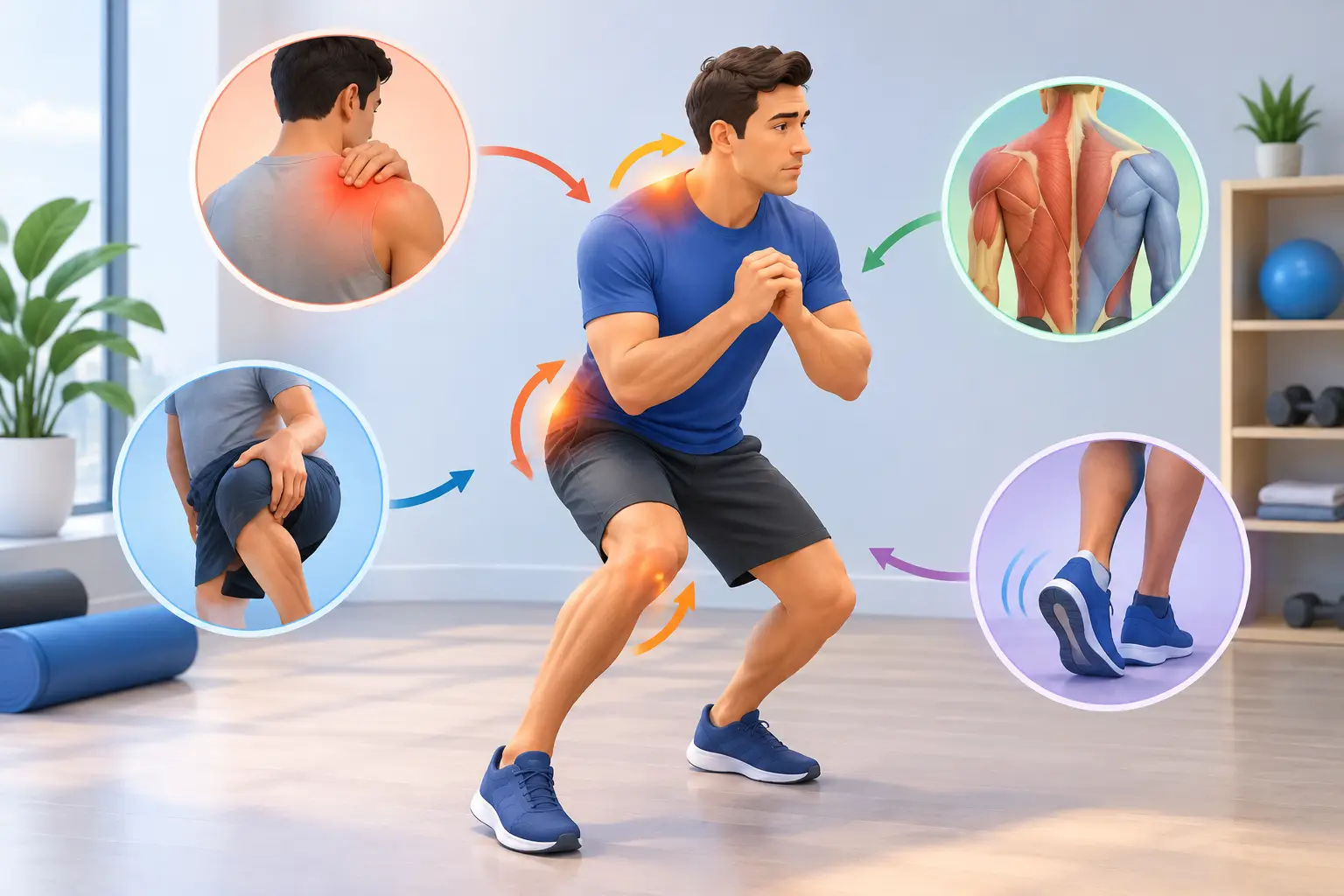
A squat that shifts to one side, a shoulder that rises during an overhead press, or a knee that caves in on a run is not always a technique problem. What causes movement compensations is often the body’s attempt to complete a task with the options it currently has. That strategy can be useful in the short term. Repeated long enough, it can make the same areas work harder while the underlying limitation stays hidden.
For active adults, this is why a painful hip, knee, back, or shoulder may keep returning after rest, stretching, or treatment focused only on the sore spot. The pain site matters, but it may not be the starting point. A whole-body look at how you move helps answer a more useful question: what is your body trying to work around?
What is a movement compensation?
A movement compensation happens when one joint, muscle group, or movement pattern does extra work because another area cannot contribute as expected. Your body is designed to adapt. If your ankle does not bend well enough to allow a deep squat, you may turn your feet out, let your arches collapse, shift into one hip, or round your lower back to get lower.
None of those adjustments automatically means something is damaged. Many people have harmless movement differences, and no two bodies move exactly alike. The concern is a pattern that is new, uneven, painful, progressively restricted, or consistently limiting the activities you care about.
Compensation is also task-specific. You might walk comfortably but notice a problem only when you run hills, lift overhead, play pickleball, or get out of a low car. The higher the demand, the less room there is for a weak link to stay unnoticed.
What causes movement compensations?
Movement compensations rarely come from one isolated cause. More often, they reflect a combination of mobility, strength, control, load, past experience, and daily habits. Clear measurements can help separate the most relevant finding from a long list of possible explanations.
Pain changes the way your nervous system organizes movement
Pain is one of the most common drivers. When an area hurts, your nervous system may reduce force through it, limit its range, or move around it before you consciously decide to do so. Someone with a sore right knee may push harder through the left leg when standing from a chair. A person with shoulder pain may shrug the shoulder toward the ear rather than reaching fully overhead.
That does not mean every compensation is a sign of injury, nor does it mean pain must disappear before movement improves. It does mean persistent pain can teach the body a protective strategy. Once the strategy becomes familiar, it may remain even after symptoms settle unless you gradually restore confidence, capacity, and control.
Limited mobility forces nearby joints to help
Joints have different jobs. The ankle, hips, upper back, and shoulders each need enough usable range for everyday movement and sport. When one area is restricted, another area often provides motion it was not meant to provide in the same amount.
For example, limited ankle dorsiflexion can change a squat, lunge, landing, or stair descent. Restricted hip rotation may show up as knee collapse or excessive foot turn-out. A stiff upper back can make the neck and low back work harder during overhead movement.
Mobility is not simply about being flexible. Passive range on a table and usable range under load are different things. The goal is not to chase extreme flexibility. It is to build the range your body needs to move well during the tasks you actually perform.
Strength deficits and poor endurance expose a pattern under load
A movement can look fine for one repetition and break down after 20. This is where strength and endurance matter. If the muscles that stabilize the trunk, pelvis, shoulder blade, or foot fatigue early, the body may shift toward a stronger area or take a shortcut through joint position.
Consider a runner whose knee stays aligned early in a run but drifts inward after several miles. The issue may involve hip strength, foot and ankle control, running load, recovery, or all of the above. Calling it simply a “weak glute” is usually too simplistic. Good assessment asks when the pattern appears, what changes it, and what the rest of the body is doing at the same time.
Motor control affects how well you use the capacity you have
You can be strong and mobile yet still compensate. Motor control is the ability to coordinate timing, position, balance, and force. It helps you keep your trunk steady while your hips move, control a single-leg landing, or maintain a shoulder position while pressing.
This is why corrective exercise is not just stretching or strengthening. The nervous system needs practice using the new option in the right context. A person may have enough hip motion to squat evenly but still favor one side because that is the pattern their body has rehearsed for years.
Old injuries, surgeries, and repeated overload leave an imprint
An old ankle sprain, a previous back episode, a knee surgery, or months of training through discomfort can influence movement long after the original event. Sometimes range, strength, or balance never fully returns. In other cases, the physical capacity is back, but the protective movement strategy remains.
Training errors can have a similar effect without a single memorable injury. A rapid increase in running mileage, heavy lifting without enough recovery, long workdays at a desk followed by intense weekend activity, or repeatedly practicing poor mechanics can exceed what the body currently tolerates. The result is not always pain right away. It may first appear as stiffness, asymmetry, reduced depth, or a feeling that one side never moves the same.
Daily habits and body position can narrow your options
Sitting is not inherently harmful, and there is no perfect posture to hold all day. But spending long periods in one position can make certain movements feel less available when you stand up to train. A desk-bound professional may notice stiff hips, limited upper-back rotation, or poor neck endurance during workouts, especially when exercise volume rises faster than mobility and strength work.
The answer is not to blame a chair. It is to recognize that your daily inputs affect your starting point. Regular movement breaks, varied positions, and a training plan that matches your current capacity can reduce the gap between how you live and how you want to perform.
Why treating the painful area alone can fall short
The location of symptoms is not always the source of the movement problem. A knee may be irritated because the foot lacks control, the ankle lacks motion, the hip cannot manage load, or the trunk shifts during single-leg tasks. A tight neck may be working overtime because the upper back and shoulder blade do not contribute well overhead.
This does not mean every problem begins somewhere far away. Sometimes the painful area truly needs direct care. The practical point is that effective care should not stop there. It should test the local area, then examine the movement chain above and below it, along with the task that brings symptoms on.
That approach prevents another common mistake: correcting every asymmetry. Not every difference needs to be fixed. A meaningful finding is one that connects to pain, limited function, reduced performance, or a goal that matters to you.
How to identify the compensation worth addressing
Watching yourself in a mirror can reveal clues, but it cannot tell the full story. A useful movement assessment looks at posture, mobility, balance, strength, core control, and movement quality together. It also compares sides and examines how your form changes under the specific demands you face.
At SYMYO Sports Therapy, the purpose of a comprehensive movement assessment is not to label your body as broken. It is to produce clear measurements, show how the pieces connect, and identify what to work on first. A Physical Health Report and Movement Age™ score can make an unclear problem more concrete, especially when you feel capable in some settings but limited in others.
The best next step depends on what the assessment finds. If pain is highly irritable, reducing aggravating load and calming symptoms may come first. If mobility is the main restriction, targeted mobility work may create room for better movement. If the pattern breaks down under fatigue, progressive strength and control training are usually more useful than another round of passive stretching.
Change the pattern with the right sequence
Lasting change usually follows a sequence: reduce what is aggravating the system, restore the missing movement or capacity, then reinforce it in the activities you value. This is more effective than forcing perfect form while pain is high or adding heavy load before your body can control the pattern.
Start with the movement that exposes the problem, but scale it to a level you can perform well. A painful deep squat may begin with a supported squat to a box. An unstable single-leg landing may begin with controlled balance and step-down work. Progress should be measured by more than whether an exercise feels hard. Look for better symmetry, more comfortable range, improved control, and greater tolerance for the things you want to do.
If pain follows a significant injury, includes numbness or progressive weakness, causes unexplained swelling, or comes with other concerning symptoms, seek appropriate medical evaluation rather than trying to self-correct through exercise.
Your body is not failing when it compensates. It is offering a solution to a problem it has not fully solved. The useful next move is to measure the pattern, understand why it is happening, and build back the options that let you move with more confidence.
Want to Understand How Your Body Is Actually Moving?
If you have tried to fix your posture, loosen tight muscles, or follow random exercises and still do not know what your body needs, an assessment can help.
The SYMYO Movement & Performance Assessment measures your mobility, strength, balance, posture, and overall movement. You will understand what is working well, where there is room to improve, and what deserves attention.
Learn About the AssessmentAbout Dr. Mitch Israel

I'm Dr. Mitch Israel, a sports chiropractor and rehab specialist and the owner of SYMYO Sports Therapy in Farmington Hills, Michigan.
I created SYMYO to help people do more than temporarily feel better.
My goal is to help you understand your body, improve what actually needs improving, and build the strength and confidence to keep doing the things you enjoy.
When general advice is not enough, a personalized assessment and plan can make the difference.
SYMYO Sports Therapy
33930 West 8 Mile Road, Suite 2AFarmington Hills, MI 48335
Serving Farmington Hills, Novi, Northville, Livonia, Plymouth, West Bloomfield, Farmington, and surrounding Metro Detroit.